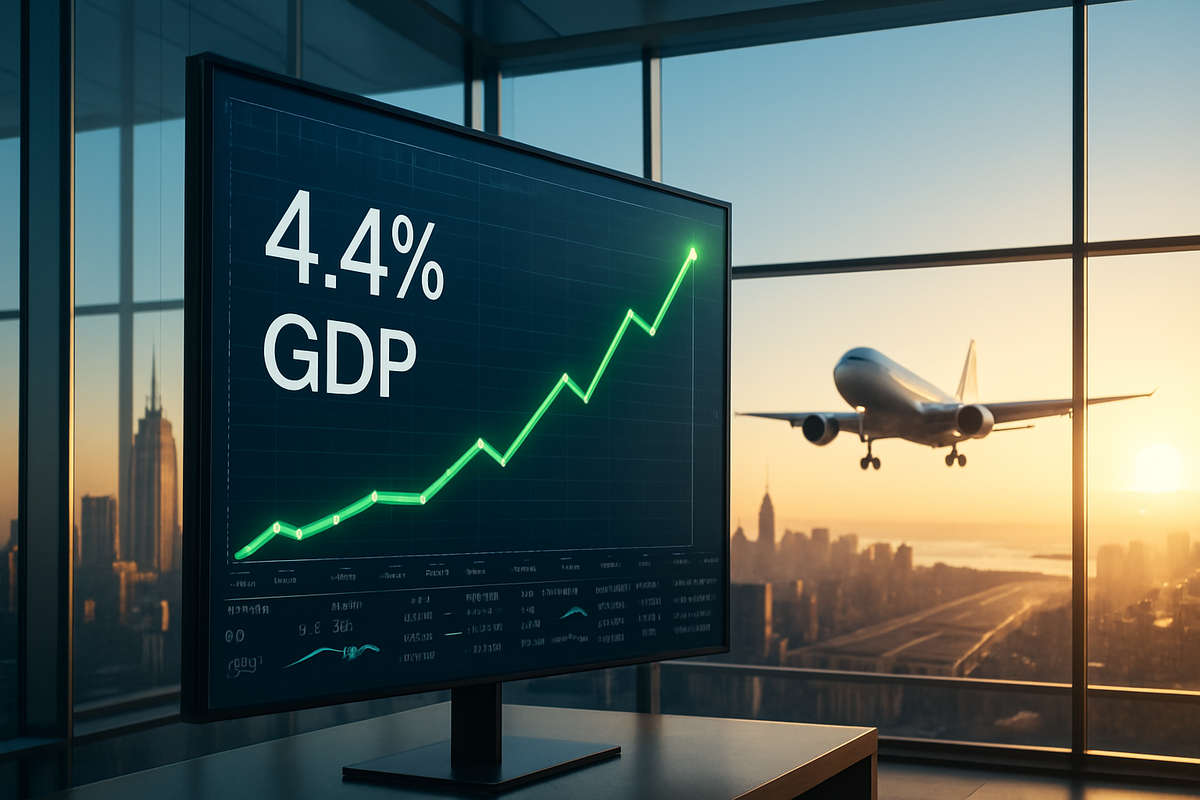
The U.S. economy has once again proven its resilience, as newly revised data shows the nation’s output expanded at a robust 4.4% annualized rate in the third quarter of 2025. This figure, released by the Bureau of Economic Analysis (BEA), surpassed the initial 4.3% estimate and beat the consensus expectations of Wall Street analysts. Coming on the heels of a volatile year of geopolitical uncertainty and shifting fiscal policies, the GDP beat has ignited a fresh wave of optimism, reinforcing the long-sought "soft-landing" scenario where inflation cools without a broader economic contraction.
For investors, the 0.1% upward revision is more than just a rounding error; it represents a fundamental shift in market sentiment. As of January 23, 2026, the S&P 500 and Nasdaq are riding a multi-day rally fueled by the realization that consumer spending remains unshakable and exports are surging. With the Federal Reserve’s next policy meeting looming, the data suggests that the "Goldilocks" economy—neither too hot to spike inflation nor too cold to trigger a recession—is firmly in place.
A Resilience Story: Breaking Down the 4.4% Print
The revised Q3 data paints a picture of an economy firing on multiple cylinders. The jump from the 4.3% initial estimate to the final 4.4% was primarily driven by a massive 9.6% surge in exports and a significantly lower-than-expected drag from private inventories. While many economists had predicted a slowdown in late 2025, the American consumer continued to spend, with personal consumption expenditures growing by 3.5%. This spending was particularly concentrated in healthcare, international travel, and prescription drugs, signaling that high-end discretionary spending and essential services are both holding firm.
The timeline leading to this moment has been marked by significant fiscal intervention. The One Big Beautiful Bill Act (OBBBA), signed into law in July 2025, provided a critical fiscal tailwind through permanent tax cuts that sustained household disposable income throughout the latter half of the year. Furthermore, the "Davos Relief" rally of January 2026 has played a massive role in recent market behavior. After a period of high tension regarding aggressive trade and territorial proposals, the administration's recent signals of de-escalation at the World Economic Forum have allowed markets to focus back on core economic fundamentals rather than geopolitical "noise."
Winners and Losers in the Post-Revision Landscape
The unexpected strength of the GDP report has created a clear set of winners, particularly among the "Magnificent 7" and companies tied to the massive infrastructure of Artificial Intelligence. Meta Platforms (NASDAQ: META) saw its stock jump 4.22% following the report, benefiting from both the economic optimism and the broader tech rally. Similarly, Microsoft (NASDAQ: MSFT) and Apple (NASDAQ: AAPL) have seen increased demand as the "Intellectual Property Products" component of the GDP report showed that business investment in AI software and processing equipment is not slowing down.
Tesla (NASDAQ: TSLA) and Visa (NYSE: V) are also positioned to benefit from the report’s confirmation of consumer strength. As unemployment remains low and wages stable, the payments sector and high-ticket consumer goods like electric vehicles are seeing renewed interest. Conversely, the report highlighted some losers in the form of massive legal settlements. While not named in the BEA summary, a domestic health insurance provider and a major e-commerce giant (widely speculated to be Amazon (NASDAQ: AMZN)) faced multi-billion dollar drags on their corporate profit data due to antitrust and deceptive enrollment settlements, respectively.
Wider Significance: The AI Capex and the 'TACO' Trade
This GDP beat is not just a statistical anomaly; it is a signal of a broader structural shift in the US economy. The heavy contribution of AI-related capital expenditures to the GDP suggests that the "AI Revolution" is now a measurable driver of national growth. This fits into a larger industry trend where tech giants are no longer just service providers but are essentially the new industrial backbone of the country. Furthermore, the market has developed a peculiar resilience to political volatility, often referred to by traders as the "TACO" (Trump Always Chickens Out) trade—a phenomenon where the market brushes off aggressive policy proposals in anticipation of eventual moderate compromises.
Historically, reaching a 4.4% growth rate this late in a business cycle is rare, especially following a period of aggressive interest rate hikes. The current situation draws comparisons to the late 1990s, where productivity gains from the internet allowed for high growth and manageable inflation. Today, AI appears to be playing that same role, providing a productivity buffer that allows the economy to absorb higher interest rates without buckling.
The Road Ahead: FOMC and Earnings Week
As we move toward the final week of January 2026, all eyes are on the Federal Open Market Committee (FOMC) meeting scheduled for January 28. The 4.4% GDP figure complicates the Fed’s path; while the growth is welcome, the PCE inflation index remains slightly above the 2% target at roughly 2.8%. Investors are now debating whether the Fed will maintain its current pause or if the strength of the economy will give them room to keep rates "higher for longer" to ensure inflation is fully defeated.
The coming days will also see a "Superbowl" of corporate earnings. Microsoft (NASDAQ: MSFT), Meta Platforms (NASDAQ: META), Tesla (NASDAQ: TSLA), and ASML Holding (NASDAQ: ASML) are all set to report earnings on the same day as the Fed's interest rate decision. This collision of macroeconomic data and microeconomic performance will likely dictate the market's direction for the remainder of Q1 2026. Strategic pivots may be necessary for those heavily hedged against a recession, as the "soft-landing" looks more like a "no-landing" scenario of sustained, high-level growth.
Summary of the Market Pulse
The revision of Q3 GDP to 4.4% marks a pivotal moment for the US economy in 2026. It confirms that despite high interest rates and geopolitical theater, the fundamental drivers of the American economy—consumer spending, exports, and technological investment—are in excellent health. The "soft-landing" is no longer a hopeful theory; it is the current reality for Wall Street.
Moving forward, investors should keep a close watch on the upcoming earnings reports and the Fed's commentary. While the headline growth numbers are spectacular, the "under-the-hood" data on inflation and corporate legal liabilities will be the true test of market stability. For now, the sentiment is overwhelmingly positive, as the US economy continues to defy the gravity of historical cycles.
This content is intended for informational purposes only and is not financial advice.