The United Nations Food and Agriculture Organization (FAO) released its highly anticipated December 2025 Food Price Index report on January 9, 2026, revealing a complex picture of the global kitchen table. While the month of December saw a notable dip in the prices of dairy, meat, and vegetable oils, the broader data confirms that 2025 was the most expensive year for food on record. The index averaged 127.2 points for the full year, a 4.3% increase over 2024, signaling that despite a late-year cooling trend, the structural pressures of the agriculture and livestock sectors continue to weigh heavily on global consumers.
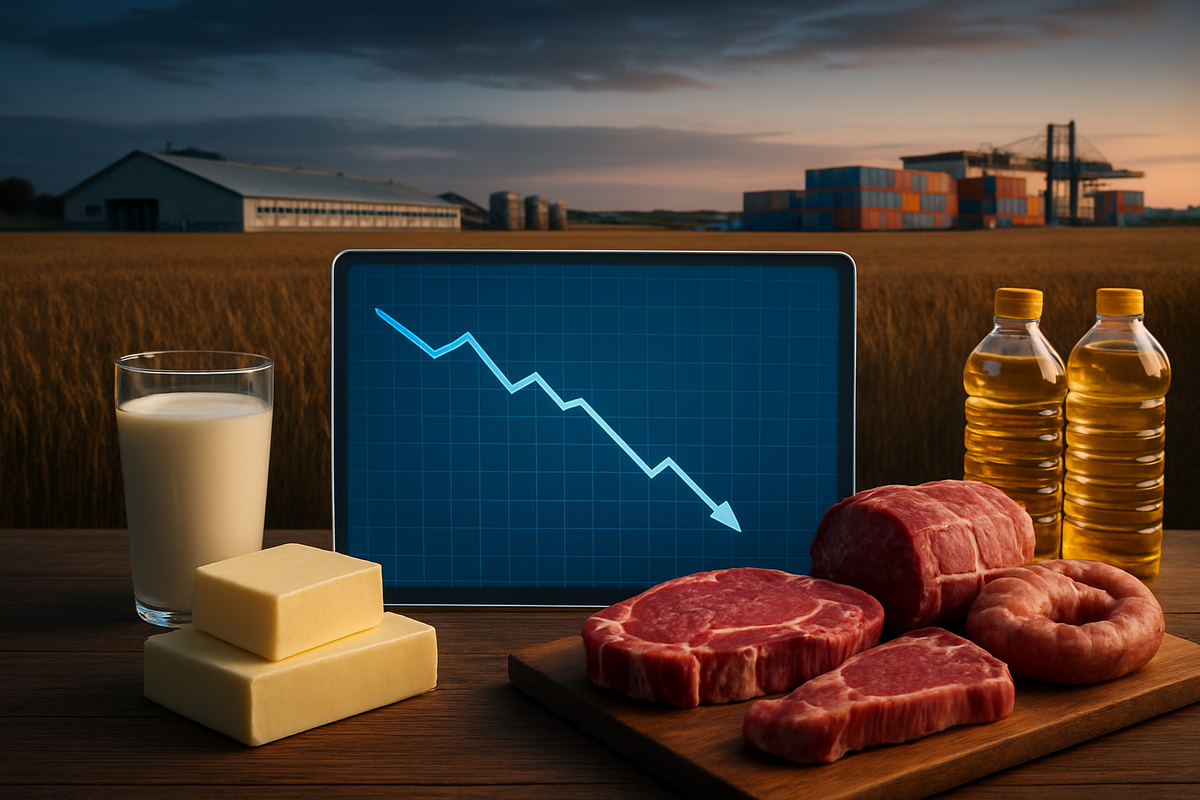
The immediate implication of the December dip is a cautious sigh of relief for central banks and policymakers who have spent the last twelve months battling stubborn food inflation. The FAO Food Price Index (FFPI) fell to 124.3 points in December, marking the fourth consecutive monthly decline. This downward trajectory at the end of the year suggests that the aggressive supply-side shocks seen in early 2025—ranging from avian flu outbreaks to tight palm oil supplies—are finally beginning to resolve, even as geopolitical tensions in the Black Sea and shifting trade policies keep the market on edge.
Year-End Relief Amidst a Record-Breaking Year
The December decline was driven largely by a sharp correction in the dairy sector, which saw a 4.4% month-over-month drop. This was primarily attributed to an unexpected surge in cream availability across Europe, which sent prices for butter and milk powder tumbling from their mid-year peaks. Similarly, the meat index fell by 1.3% in December as poultry and bovine supplies increased, providing a slight reprieve from a year where animal disease and high feed costs had pushed protein prices to uncomfortable highs. Vegetable oils also reached a six-month low in December, dipping 0.2% as soy and sunflower oil supplies from South America began to hit the market.
However, the timeline of 2025 tells a story of two halves. The first six months of the year were characterized by extreme volatility and record-high prices for vegetable oils and dairy, which drove the annual average to its historic peak. While the latter half of the year saw a steady cooling, the cumulative effect left the 2025 average significantly higher than 2024. Key stakeholders, including the World Bank and the International Monetary Fund (IMF), have noted that while the "peak" may be behind us, the floor for food prices has been permanently raised by higher labor costs and the increasing frequency of climate-related crop failures.
Initial market reactions have been mixed. Commodity traders have already begun pricing in a more "normal" 2026, though the cereal sector remains a point of concern. Unlike dairy and meat, the cereal price index actually rose 1.7% in December, fueled by renewed export risks in the Black Sea region and concerns over wheat harvests in the Southern Hemisphere. This divergence highlights the fragmented nature of the current recovery, where some grocery aisles are seeing relief while others remain under significant pressure.
Winners and Losers in the Agriculture Sector
The agriculture and livestock giants have had to navigate this "high-cost, high-volatility" environment with varying degrees of success. Archer-Daniels-Midland (NYSE: ADM) and Bunge Global SA (NYSE: BG) found 2025 to be one of their most challenging years in recent memory. Both companies faced thinning "crush margins"—the profit earned from processing crops into oil and meal—due to an oversupply of raw crops that depressed prices while operational costs remained high. ADM was forced to lower its 2025 profit outlook late in the year, reflecting the difficulty of maintaining margins in a cooling commodity market. However, both firms are expected to be major beneficiaries in 2026 as U.S. biofuel mandates become clearer and the Bunge-Viterra merger begins to yield operational efficiencies.
In the livestock sector, Tyson Foods (NYSE: TSN) presents a tale of two segments. The company has been a major winner in the poultry market, where it successfully optimized its supply chain to achieve double-digit margins in late 2025. Conversely, Tyson’s beef segment has been a significant loser, hamstrung by record-high cattle costs and a shrinking U.S. herd that shows no signs of recovering before 2027. Investors are watching to see if the strength in "cheap" proteins like chicken can continue to offset the bleeding in the premium beef category.
Consumer-packaged goods (CPG) companies like Danone (Euronext Paris: BN) have managed the 2025 price surge through aggressive "revenue growth management"—a polite industry term for price hikes. By focusing on high-margin categories like medical nutrition and high-protein dairy (such as Skyr), Danone managed to maintain sales growth despite the high input costs of early 2025. As dairy prices finally began to soften in December, Danone is positioned to see margin expansion in early 2026, provided they do not face a "consumer revolt" that forces them to roll back prices.
Broader Significance and Global Trends
The 2025 FAO report fits into a broader industry trend of "the new normal" for food prices. We are moving away from the era of cheap, abundant food into a period defined by supply chain fragility and climate risk. The fact that prices remained higher for the year despite the December dip suggests that "disinflation" in food is not the same as "deflation." Prices are rising more slowly, but they are not returning to 2021 levels. This has significant ripple effects on global stability, particularly in emerging markets where food accounts for a larger share of household spending.
Historically, periods of high food prices followed by a sudden dip have led to shifts in agricultural policy. We are already seeing this in the U.S. and the EU, where there is a renewed push for "food sovereignty" and domestic production subsidies to insulate local markets from global price shocks. The 2025 experience is likely to accelerate the adoption of "climate-smart" agriculture, as farmers seek to protect yields against the increasingly erratic weather patterns that caused the vegetable oil spikes earlier in the year.
Furthermore, the stabilization of fertilizer prices at the end of 2025 is a critical historical precedent. Much like the post-2008 food crisis, the current easing is being supported by a correction in energy and input costs. However, the regulatory environment is now more complex, with carbon taxes and environmental mandates in Europe adding a permanent "green premium" to food production that was not present in previous decades.
The Road Ahead: 2026 and Beyond
Looking ahead to the rest of 2026, the primary concern for the market is the strengthening La Niña weather pattern. Meteorologists warn that this could lead to droughts in key growing regions of North and South America, potentially undoing the progress made in the vegetable oil and cereal sectors during the fourth quarter of 2025. Companies will need to pivot their sourcing strategies quickly to avoid being caught in another supply squeeze.
In the short term, we expect to see a "battle of the brands" in grocery stores. As commodity prices for dairy and meat ease, retailers will likely demand that CPG companies lower their wholesale prices or increase promotional spending. This could lead to a temporary dip in profit margins for the likes of Nestle (SWX: NESN) and Kraft Heinz (NASDAQ: KHC) as they fight to retain market share from private-label brands that gained ground during the 2025 price peaks.
Long-term, the focus will shift to the livestock "rebuilding phase." For the beef industry to recover, ranchers need to stop slaughtering cows and start growing their herds, a process that takes years. This means that while chicken and pork prices may stabilize or fall in 2026, beef is likely to remain a luxury item for the foreseeable future, creating a sustained market opportunity for alternative protein providers and poultry producers.
Market Wrap-Up and Investor Outlook
The FAO’s December report marks the end of a grueling year for global food security. The key takeaway is that while the "inflationary fire" has been largely contained, the "heat" remains. The 4.3% annual increase in the price index serves as a stark reminder that the global food system is operating at a higher cost basis than ever before. For investors, the focus must move from "who can pass on costs" to "who can operate most efficiently" in a lower-margin, high-volume environment.
Moving forward, the market will be characterized by a "wait and see" approach regarding weather and trade policy. The cooling of dairy and meat prices provides a much-needed buffer, but it is a fragile one. Investors should keep a close eye on the FAO’s monthly updates through Q1 2026, specifically looking for any signs that the cereal index is beginning to follow the downward trend of other commodities.
Ultimately, the 2025 food price story is one of resilience. Despite historic challenges, the global supply chain has avoided a total breakdown, and the year-end dip offers a glimmer of hope for a more stable 2026. However, the era of volatility is far from over, and the lessons of 2025 will likely dictate corporate and government strategy for the rest of the decade.
This content is intended for informational purposes only and is not financial advice