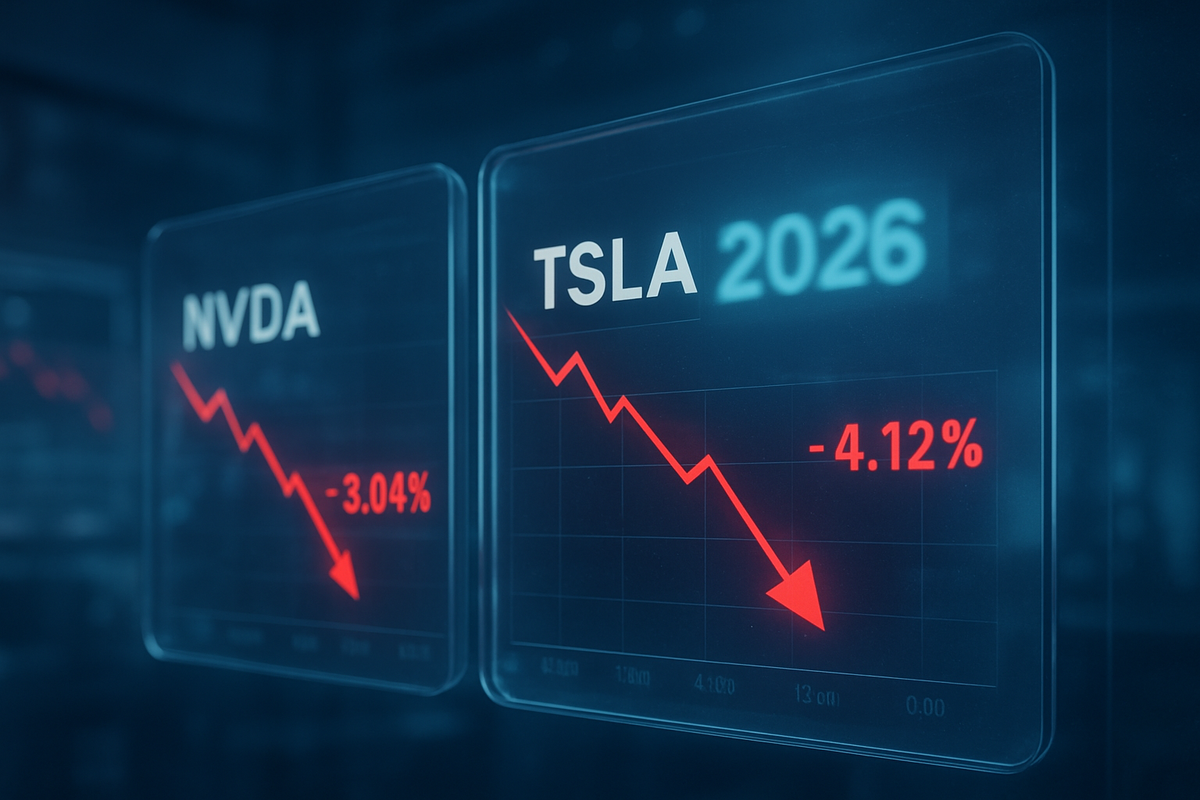
The final trading sessions of 2025 have delivered a sobering reality check to a market that spent much of the year in a state of AI-driven euphoria. In a rare departure from the historical "Santa Claus rally," major indices including the S&P 500 and the Nasdaq Composite stumbled through the last week of December, led downward by the very tech giants that had previously propelled the bull market to record heights. The late-December slip has wiped billions in market capitalization from industry leaders, leaving investors to enter the 2026 New Year with a defensive posture.
This sudden cooling of sentiment comes as a surprise to many who expected a festive finish to a strong year. Instead, the final four trading days of 2025 were characterized by a coordinated retreat in the "Magnificent Seven," fueled by a combination of aggressive profit-taking, shifting tax policies, and a looming "tax credit cliff" for the electric vehicle sector. As the market prepares for the first opening bell of 2026 this Friday, the focus has shifted from growth at any cost to the sustainability of current valuations in a more restrictive trade environment.
The Four-Day Slump: A Failure of Festive Momentum
The final week of 2025 saw a dramatic reversal of the momentum that had defined the earlier months. The S&P 500 (INDEXSP: .INX) fell for four consecutive sessions ending on December 31, closing the final day of the year down 0.74%. This marked the most widespread sell-off the index had seen since May, with a staggering 97% of its constituents failing to post gains on the final day of trading. The decline was most pronounced in the tech-heavy Nasdaq, which buckled under the weight of high-multiple stocks that had become vulnerable to technical exhaustion.
Nvidia (NASDAQ: NVDA) was at the center of this year-end volatility. After a year that saw the semiconductor giant gain roughly 40%, the stock faced significant selling pressure in the final week. On Monday, December 29, Nvidia shares dropped 1.8% to close near $190.53, followed by a further soft slide through the final two days of the year. The retreat was largely attributed to "valuation fatigue" and investor skepticism regarding the company's recent capital-allocation strategy. Specifically, Nvidia’s $5 billion private stock purchase of Intel (NASDAQ: INTC) and a massive $20 billion licensing deal with AI startup Groq had some analysts questioning if the company was spreading its resources too thin.
Tesla (NASDAQ: TSLA) experienced even more dramatic swings. Just days after hitting an all-time high of $498.83 on December 22, the electric vehicle pioneer saw its shares tumble 4.5% in early trading on December 29, eventually settling at $475.19. The catalyst for the decline was the impending "tax credit cliff"—the fallout from the repeal of the $7,500 federal EV tax credit. This policy shift triggered a massive "pull-forward" of sales into the third quarter, leaving the fourth-quarter delivery outlook looking increasingly lean. By the time the final bell rang on New Year's Eve, Tesla had surrendered a significant portion of its December gains, ending the year with a cumulative rise of approximately 12%.
Winners and Losers in the Year-End Shuffle
While the broader market felt the sting of the year-end retreat, the implications vary significantly across the corporate landscape. Nvidia, despite its late-month stumble, remains a primary beneficiary of the AI infrastructure build-out. However, the market’s reaction to its $5 billion stake in Intel (NASDAQ: INTC) suggests that investors are becoming more discerning about "mega-cap" mergers and acquisitions. For Intel, the infusion of capital from Nvidia provides a much-needed lifeline as it continues its turnaround efforts, yet its stock remains tethered to the broader volatility of the semiconductor sector.
On the losing side, Tesla (NASDAQ: TSLA) faces a challenging start to 2026. The repeal of federal tax incentives has created a demand vacuum that the company must now navigate. Analysts are forecasting a 15% year-over-year decline in vehicle deliveries for the fourth quarter of 2025, a figure that could lead to further downward pressure when the official report is released this Friday. Other EV manufacturers and legacy automakers transitioning to electric fleets are also feeling the burn, as tax-loss harvesting in the final days of December saw investors dumping shares in underperforming automotive names to offset gains elsewhere.
The broader tech sector, including companies like Apple (NASDAQ: AAPL) and Microsoft (NASDAQ: MSFT), also saw their gains trimmed as institutional managers moved to "lock in" performance bonuses. This period of technical rebalancing often creates "winners" out of those who hold cash, as the low-volume holiday trading environment (which saw participation 45% below the 20-day average) exacerbated price swings. For long-term value investors, however, the dip in AI-related stocks may present a entry point, provided the earnings growth of these companies can continue to justify their still-lofty multiples.
Policy Shocks and the End of the AI Honeymoon
The failure of the 2025 Santa Claus rally is not merely a technical event; it is a reflection of shifting geopolitical and economic undercurrents. A major contributor to the "risk-off" sentiment in late December was renewed rhetoric regarding aggressive trade policies, including the possibility of 100% tariffs on goods from China and new levies on North American partners. These potential policy shifts have introduced a layer of uncertainty for companies with global supply chains, particularly those in the hardware and semiconductor industries that rely heavily on international manufacturing hubs.
Historically, the end of a year often sees a "window dressing" effect where fund managers buy winning stocks to make their portfolios look better for year-end reports. In 2025, however, the opposite occurred. The sheer magnitude of the gains in the first half of the decade has led to a period of "profit-taking gravity." This mirrors previous market cycles, such as the post-2000 dot-com era or the 2021 tech peak, where extreme concentration in a few "super-stocks" eventually led to a period of broader market rebalancing.
The AI sector is also entering what some analysts call the "execution phase." The initial hype that drove triple-digit returns in 2024 has transitioned into a more skeptical environment in late 2025. Investors are no longer satisfied with the promise of AI; they are demanding proof of monetization and efficient capital expenditure. The mixed reaction to Nvidia’s recent deals indicates that the market is now scrutinizing the "how" and "when" of AI profitability, rather than just the "if."
The Road Ahead: Setting the Stage for 2026
All eyes are now on Friday, January 2, 2026, the first trading day of the new year. The market setup is one of heightened tension, as traders must digest two days of global news during the New Year’s Day closure. A major catalyst for Friday’s open will be Tesla’s (NASDAQ: TSLA) Q4 delivery report. Consensus estimates are currently hovering between 422,000 and 450,000 vehicles. If the numbers come in at the lower end of that range, it could trigger a broader sell-off in the consumer discretionary sector.
In addition to corporate earnings, key economic data will set the tone for the first quarter. At 9:45 AM ET on Friday, the Manufacturing PMI report will be released, with a forecast of 51.8. A reading below this mark would suggest that the manufacturing sector is cooling faster than anticipated, potentially prompting the Federal Reserve to reconsider its interest rate trajectory for the coming year. Construction spending data will follow at 10:00 AM ET, providing further clues about the health of the domestic economy.
The ceremonial start to the 2026 trading year will be marked by NovaBridge Biosciences (NASDAQ: NBP), which is scheduled to ring the Nasdaq Opening Bell. While the ceremony offers a moment of optimism, the technical outlook remains cautious. Analysts note a "two-day price discovery gap" that could lead to a volatile opening. If the market fails to find a floor on Friday, it may signal a deeper correction for the first quarter of 2026, forcing a strategic pivot toward more defensive, value-oriented sectors.
Summary of the Year-End Shift
The late-December slip of 2025 serves as a potent reminder that even the most robust bull markets are subject to the laws of technical exhaustion and policy shifts. The failure of the Santa Claus rally, driven by retreats in Nvidia (NASDAQ: NVDA) and Tesla (NASDAQ: TSLA), has reset expectations for the year ahead. Investors have shifted from a "fear of missing out" to a "fear of overpaying," a transition that will likely define the market dynamics of early 2026.
As we move into the first months of the new year, the key watchwords will be "valuation" and "policy." The resilience of the AI sector will be tested by its ability to deliver tangible earnings, while the automotive and consumer sectors must navigate the removal of government incentives and the threat of new tariffs. For the individual investor, the current volatility underscores the importance of a diversified portfolio and a watchful eye on the macroeconomic signals coming from Washington and the Federal Reserve.
The coming months will determine whether the year-end slip was a temporary pause in a long-term bull run or the beginning of a more significant structural shift in the market. For now, the focus remains on Friday’s opening bell and the critical data points that will provide the first roadmap for the 2026 investment landscape.
This content is intended for informational purposes only and is not financial advice