
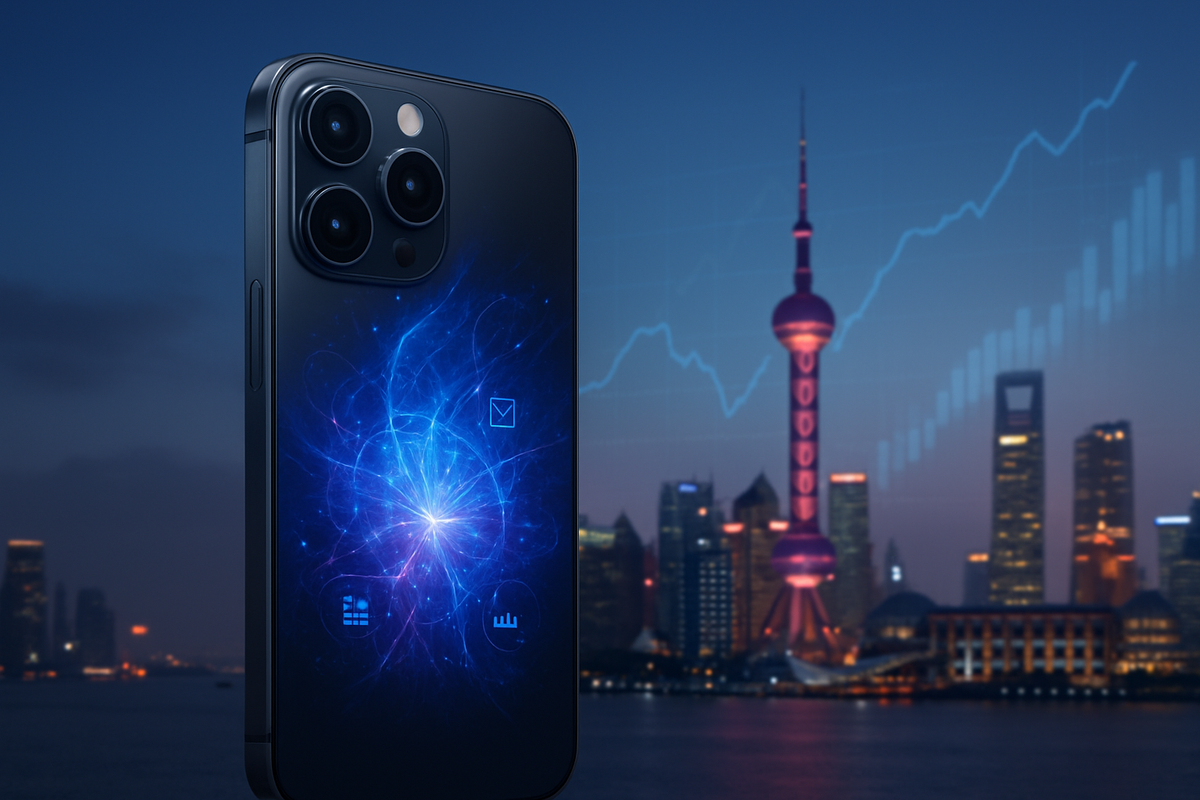
As of December 25, 2025, Apple Inc. (NASDAQ: AAPL) has orchestrated one of the most significant market turnarounds in recent tech history. After a turbulent 2024 defined by regulatory headwinds and a resurgence from domestic Chinese competitors, the Cupertino giant has surged back to dominance in the world's largest smartphone market. This resurgence is anchored by a massive uptick in iPhone 17 shipments and a feverish market anticipation for "Siri 2.0"—the next-generation, agentic AI platform that has redefined the consumer electronics landscape over the past twelve months.
The immediate implications are profound: Apple has effectively neutralized the "Huawei threat" that dominated headlines a year ago, leveraging a localized AI strategy that bridges the gap between Silicon Valley innovation and Beijing’s strict regulatory environment. With shipment growth in China hitting double digits and a multi-year upgrade cycle now in full swing, Wall Street analysts are aggressively recalibrating their 2026 price targets, with some now eyeing a $3.5 trillion to $4 trillion market capitalization for the tech titan.
A Year of Redemption: The iPhone 17 and the China Pivot
The timeline of Apple’s recovery began in late 2024, when the company’s market share in China dipped to approximately 17%, trailing behind Huawei and Xiaomi Corp. (HKG: 1810). Critics argued that Apple was "late to the AI party," but the September 2025 launch of the iPhone 17 series silenced skeptics. Within the first ten days of its release, the iPhone 17 saw a 14% increase in unit sales compared to its predecessor. Most notably, the base iPhone 17 model witnessed a 100% surge in China, driven by a more powerful A19 chip and the promise of fully localized AI features.
By October 2025, Apple’s monthly sales in China had jumped 37% year-over-year. This momentum was sustained by the phased rollout of "Apple Intelligence," which reached critical mass in late 2025. Key stakeholders, including Apple CEO Tim Cook and Chinese regulatory bodies, spent the better part of the year negotiating the framework for Siri 2.0’s operation within the mainland. The result was a sophisticated hybrid model that utilizes local cloud infrastructure while maintaining Apple’s signature end-to-end encryption for on-device processing.
Initial market reactions have been overwhelmingly positive. Investors who feared a permanent loss of market share to Huawei’s Mate and Pura series have returned to Apple, viewing the iPhone not just as a hardware device, but as the "Gen AI base camp" for the average consumer. The data from Q3 2025 confirms this shift, with Apple reclaiming a top-tier position and reaching a 15.8% market share, effectively halting the momentum of domestic rivals who had previously capitalized on patriotic buying trends.
The AI Ecosystem: Winners, Losers, and Strategic Partners
The primary winner in this saga is undoubtedly Apple, which has proven its ability to maintain premium pricing power while navigating complex geopolitical waters. However, the surge has created a ripple effect across its partner network. Alibaba Group Holding Ltd. (NYSE: BABA) and Baidu Inc. (NASDAQ: BIDU) have emerged as essential allies. To comply with the Cyberspace Administration of China (CAC), Apple integrated Alibaba’s compliance engines and Baidu’s localized search and visual intelligence tools into Siri 2.0. This partnership has turned former potential rivals into critical infrastructure providers for Apple’s Chinese ecosystem.
Conversely, domestic hardware manufacturers like Huawei and Vivo have felt the squeeze. While Huawei remains a formidable player, the "novelty" of its home-grown HarmonyOS has faced a stiff challenge from the sheer utility of Apple’s cross-app AI intelligence. Xiaomi, while maintaining a strong mid-range presence, has struggled to match Apple’s high-end Average Selling Price (ASP) as consumers prioritize the seamless integration of Siri 2.0 with their existing Apple hardware.
In the supply chain, Taiwan Semiconductor Manufacturing Co. (NYSE: TSM) continues to reap the rewards of Apple’s silicon dominance. The A19 and A19 Pro chips, built on an advanced 2nm-class process, are the only mobile processors currently capable of running Siri 2.0’s "World Knowledge Answers" (WKA) feature with low latency. This has created a bottleneck for competitors who are still optimizing their AI models for less efficient hardware architectures.
The Siri 2.0 Paradigm: A Shift in Global Consumer Tech
The significance of Siri 2.0 extends far beyond a simple software update; it represents a fundamental shift in how humans interact with technology. By December 2025, Siri has evolved from a voice assistant into an autonomous agent capable of "on-screen awareness" and "cross-app action control." This means the assistant can now understand personal context—pulling data from emails, calendars, and encrypted messages—to perform multi-step tasks like booking travel or managing finances without the user ever opening a specific app.
This event fits into a broader industry trend where hardware is no longer the primary differentiator; rather, the "intelligence layer" on top of the hardware is what drives the upgrade cycle. Apple’s success in China also sets a precedent for how global tech firms must approach localized AI. By partnering with local giants like Baidu and Alibaba, Apple has created a blueprint for navigating the "splinternet"—the growing divide between Western and Chinese digital ecosystems.
Historically, this moment is being compared to the launch of the original iPhone or the transition to the 5G era. However, the stakes are higher. The 2025 AI surge is not just about faster speeds; it is about the utility of the device. For the first time, the "replacement cycle" is being driven by a software necessity—users with older iPhones simply cannot run the agentic AI features that have now become standard in professional and social environments.
The Road to 2026: Price Targets and the Next Frontier
Looking ahead to 2026, the market is bracing for what Dan Ives of Wedbush Securities calls the "invisible AI strategy" coming to fruition. With an installed base of over 1.5 billion iPhones, the "iPhone 18" launch in late 2026 is expected to be the first device where AI features are mature and fully integrated from day one. Analysts at Morgan Stanley (NYSE: MS) have set price targets as high as $376, projecting that Apple will ship upwards of 262 million iPhones in fiscal year 2026.
The next strategic pivot for Apple will likely involve the monetization of these features. Rumors of an "Apple Intelligence+" premium subscription tier are circulating, which would provide users with even more advanced agentic capabilities and expanded cloud compute for complex tasks. This would further boost Apple’s high-margin Services revenue, which Goldman Sachs Group Inc. (NYSE: GS) predicts will become an even larger portion of the company’s valuation as AI-integrated subscriptions take hold.
However, challenges remain. The reliance on Chinese partners like Baidu and Alibaba introduces long-term geopolitical risks, and any flare-up in trade tensions could disrupt the delicate balance Apple has struck. Furthermore, as AI agents become more autonomous, Apple will face unprecedented scrutiny over data privacy and the ethical implications of "personal context" processing, even with its robust on-device encryption.
Final Outlook: A Trillion-Dollar Catalyst
The surge in China and the successful deployment of Siri 2.0 mark a definitive "new chapter" for Apple. The company has successfully navigated a period of intense skepticism, proving that its ecosystem remains the most "sticky" and profitable in the tech world. For investors, the takeaway is clear: the AI-driven upgrade cycle is not a one-quarter wonder but a multi-year phenomenon that is just beginning to reflect in the company's bottom line.
Moving forward, the market will be watching for two key metrics: the adoption rate of Siri 2.0 features among non-pro iPhone users and the potential announcement of an AI-specific revenue stream. As we enter 2026, Apple is no longer just a hardware company or a services company; it has successfully rebranded itself as the world’s premier AI orchestration platform.
The lasting impact of 2025 will be remembered as the year Apple proved it could "think different" about AI, localized regulation, and consumer utility, effectively securing its growth trajectory for the remainder of the decade.
This content is intended for informational purposes only and is not financial advice.