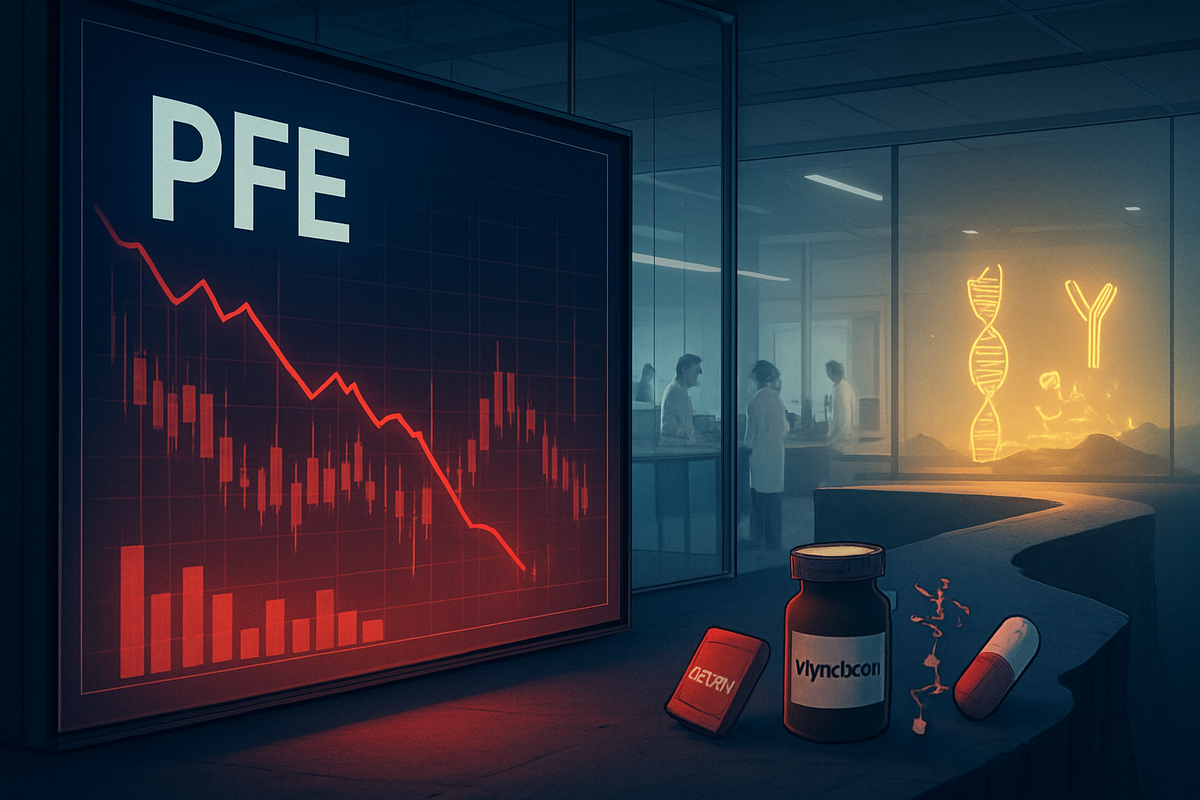
NEW YORK — On December 16, 2025, Pfizer (NYSE: PFE) issued a conservative financial outlook for the 2026 fiscal year, falling short of Wall Street’s expectations and signaling a prolonged period of transition for the pharmaceutical giant. The guidance, which highlights the dual pressures of declining COVID-19 product demand and an impending "patent cliff," sent shares tumbling as investors grappled with the reality of a slower-than-expected recovery.
The announcement marks a critical juncture for Pfizer as it attempts to pivot from its pandemic-era dominance toward a future anchored by oncology and the high-growth obesity market. However, with revenue and earnings targets coming in below consensus, the market's reaction suggests that the road to redemption may be longer and more arduous than previously anticipated.
A Muted Forecast Triggers Market Sell-Off
In its mid-December disclosure, Pfizer projected 2026 revenue in the range of $59.5 billion to $62.5 billion. The midpoint of $61 billion notably missed the analyst consensus of $61.68 billion. On the bottom line, the company expects adjusted earnings per share (EPS) of $2.80 to $3.00, trailing the $3.05 to $3.08 range that Wall Street had modeled. This conservative stance was compounded by a tightening of the 2025 revenue outlook, which was adjusted to approximately $62.0 billion.
The market response was swift and unforgiving. On the day of the release, Pfizer shares fell as much as 5.1% in intraday trading before closing down 3.4% at $25.53. The stock is currently trading near multi-year lows, reflecting a broader skepticism regarding the company's ability to replace lost revenue from its blockbuster COVID-19 franchise. Analysts from J.P. Morgan (NYSE: JPM) characterized the guidance as "conservative but largely expected," while Bank of America (NYSE: BAC) lowered its price target, citing the dilutive impact of recent acquisitions and faster-than-anticipated erosion of COVID-19 sales.
The timeline leading to this moment has been defined by a series of aggressive moves to diversify. Over the past 24 months, Pfizer has committed tens of billions of dollars to acquisitions, most notably the $43 billion purchase of Seagen and the late-2025 acquisition of the weight-loss biotech Metsera for $10 billion. Despite these efforts, the immediate financial contributions of these deals have yet to offset the $1.5 billion revenue hit expected in 2026 from products losing patent protection, including the anticoagulant Eliquis and the heart disease drug Vyndaqel.
Winners and Losers in the Shifting Pharma Landscape
The primary "loser" in this scenario is undoubtedly Pfizer (NYSE: PFE) itself, which continues to struggle with a valuation that has been effectively halved since its pandemic peaks. The soft guidance also cast a shadow over other COVID-19 vaccine makers like Moderna (NASDAQ: MRNA), as investors interpreted Pfizer’s declining Comirnaty and Paxlovid sales as a sign of a permanently diminished market for pandemic-related therapeutics.
Conversely, the "winners" appear to be Pfizer’s more specialized competitors. In the oncology space, Merck (NYSE: MRK) and Johnson & Johnson (NYSE: JNJ) remain formidable rivals, though Pfizer’s integration of Seagen’s antibody-drug conjugate (ADC) technology is beginning to show promise. Pfizer now estimates that oncology accounts for 28% of its total revenue, with drugs like Padcev projected to reach blockbuster status. However, in the lucrative obesity market, Pfizer remains a distant third behind Eli Lilly (NYSE: LLY) and Novo Nordisk (NYSE: NVO). While the Metsera acquisition provides Pfizer with a monthly injectable GLP-1 candidate, MET-097i, it is still in Phase 2b trials, leaving the market leaders to reap the lion's share of profits for the foreseeable future.
Broader Industry Trends and Regulatory Headwinds
Pfizer’s challenges are a microcosm of the broader "patent cliff" facing the pharmaceutical industry in the late 2020s. Between 2026 and 2030, several of the world’s best-selling drugs will lose exclusivity, forcing companies into a high-stakes race for innovation and M&A. Pfizer’s situation is exacerbated by the Inflation Reduction Act (IRA), which has introduced Medicare price negotiations for high-volume drugs. Eliquis, a major revenue driver for Pfizer, is among the first targets of these negotiations, further squeezing margins.
Historically, Pfizer has used massive M&A to bridge growth gaps—similar to its acquisition of Wyeth in 2009. However, the current high-interest-rate environment and increased regulatory scrutiny of large-scale healthcare mergers have made this strategy more expensive and riskier. The company’s pivot to oncology via Seagen is a direct response to these trends, as cancer treatments often command higher pricing power and longer-term clinical relevance than general primary care medications.
The Road Ahead: 2026 as a Transition Year
Looking forward, 2026 is being framed by management as a "transition year." The company is currently executing a massive cost-cutting program aimed at saving $7.2 billion by the end of 2026. If successful, these efficiencies could provide an upside to EPS even if revenue growth remains stagnant. Investors will be laser-focused on the Phase 2b data for MET-097i expected in mid-2026, as a successful entry into the weight-loss market is seen as the only catalyst capable of significantly rerating the stock.
Strategic pivots may also include further divestitures of non-core assets to focus entirely on "high-science" areas like immunology and oncology. The potential for a "breakup" of the company into specialized units remains a topic of speculation among activist investors, though CEO Albert Bourla has so far remained committed to the integrated "Big Pharma" model.
Investor Takeaway and Market Outlook
The 2026 guidance from Pfizer is a sobering reminder of the volatility inherent in the pharmaceutical sector once a "black swan" event like a pandemic recedes. The key takeaways for investors are the significant $1.5 billion impact of the 2026 patent cliff and the continued volatility of COVID-19 product utilization. While the Seagen acquisition provides a solid foundation in oncology, it is not yet enough to fill the revenue void left by older blockbusters.
Moving forward, the market will likely adopt a "wait-and-see" approach. The success of the Metsera integration and the realization of cost-cutting targets will be the primary metrics to watch. For now, Pfizer remains a high-yield, low-growth play, with its 5% dividend yield serving as the primary floor for the stock price as the company navigates one of the most challenging periods in its 176-year history.
This content is intended for informational purposes only and is not financial advice.