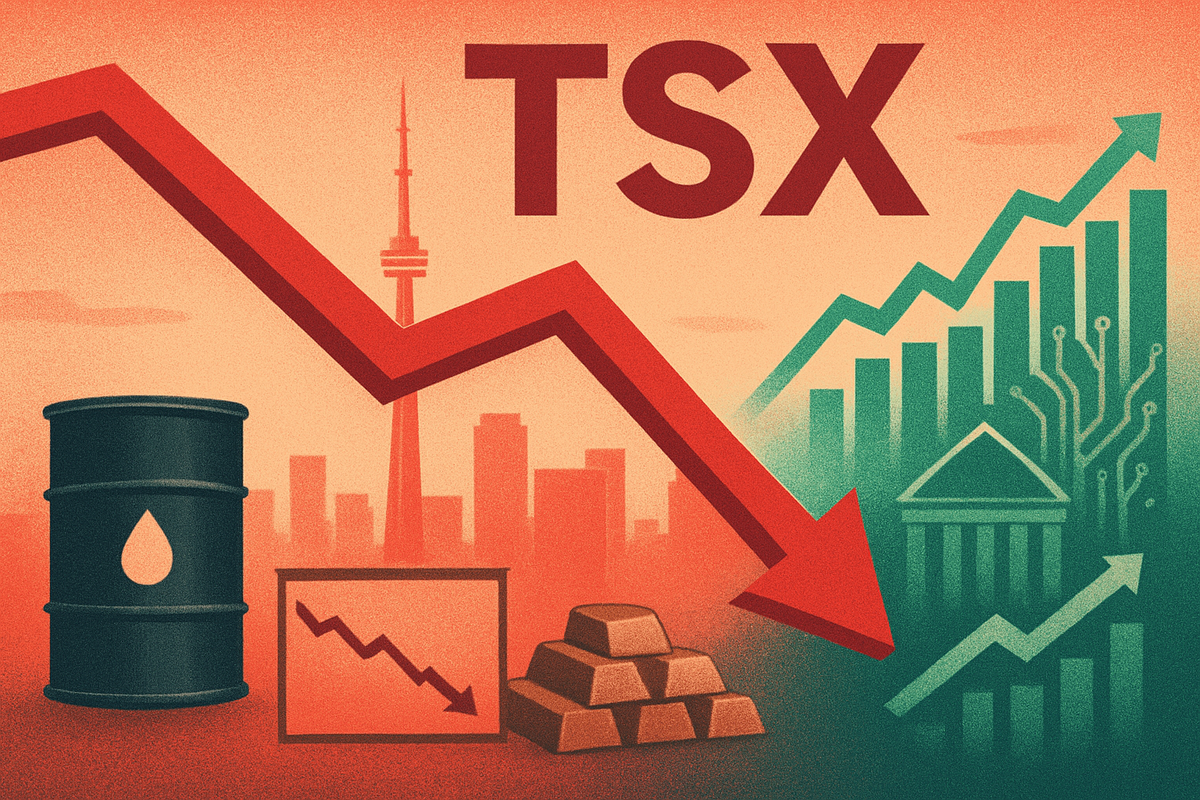
Toronto, Canada – December 2, 2025 – The S&P/TSX Composite Index recently experienced a notable downturn, snapping a robust six-session winning streak that had propelled it to multiple record highs. This market correction, observed on December 1st and continuing into December 2nd, 2025, was primarily driven by a widespread decline in commodity prices, which effectively overshadowed pockets of strength and resilience within the technology and banking sectors. The immediate implication is a shift in market sentiment, moving from an extended period of bullish momentum to a more cautious stance as investors grapple with a complex interplay of global economic signals and sector-specific performances.
This recent dip serves as a critical reminder of the Canadian market's inherent sensitivity to commodity fluctuations, even as its other sectors strive for diversification and growth. While the prior rally was fueled by increasing expectations of a U.S. interest rate cut, the current environment suggests a period of profit-taking and a re-evaluation of asset allocations, particularly concerning the future trajectory of global commodity demand and supply dynamics.
Detailed Market Correction and Sectoral Dynamics
The TSX Composite Index initiated its decline on Monday, December 1, 2025, shedding 0.9% to close at 31,102, thereby ending a significant six-session run of record-setting performances. The downward trend persisted into Tuesday, December 2nd, with the index dipping an additional 0.3% in early trading. At the core of this downturn was a broad-based retreat in commodity prices, which heavily impacted Canada's resource-rich economy. Energy stocks and mining companies bore the brunt of the sell-off, tracking significant decreases in the prices of crude oil, gold, and copper. West Texas Intermediate (WTI) crude, for instance, was trading near $58.63 per barrel, a sharp decline attributed to global oversupply and a deceleration in demand growth. This commodity weakness aligns with broader forecasts, including those from the World Bank, predicting a fourth consecutive year of overall global commodity price declines by 2026, driven by weak global economic growth and persistent policy uncertainties.
The technology sector presented a mixed picture during this period. On Monday, tech stocks initially contributed to the market's decline, with e-commerce giant Shopify (TSX: SHOP) plunging 6.3% due to reported issues in processing transactions during the critical Cyber Monday period. Other prominent tech players like Constellation Software (TSX: CSU) and Celestica (TSX: CLS) also experienced notable drops. However, the sector demonstrated resilience on Tuesday, rebounding with a 1.4% gain, closely tracking an upward movement in the tech-heavy Nasdaq. Shopify (TSX: SHOP) notably recovered, with its shares climbing 4.5% after announcing record sales figures from the Black Friday-Cyber Monday weekend, proving its resilience and growth potential even in a fluctuating market.
Similarly, the banking sector navigated a fluctuating landscape. Financial heavyweights initially traded in negative territory on Monday, as investors awaited crucial quarterly results and banks continued to manage reserve needs amidst persistent delinquency concerns. By Tuesday, however, the banking sector provided some much-needed support to the index. The Bank of Nova Scotia (TSX: BNS) led this recovery, gaining ground after exceeding its fourth-quarter profit estimates, contributing to a 0.5% rise in the broader financial sector. This performance sets an optimistic tone as investors keenly anticipate earnings reports from other major Canadian banks throughout the week, which could further influence the market's direction.
Companies Navigating the Commodity Headwinds and Sectoral Shifts
The recent market movements on the TSX highlight clear winners and losers, particularly among public companies deeply entrenched in Canada's economic fabric. Resource-focused companies, especially those in the energy and mining sectors, are feeling significant pressure. Companies like Suncor Energy Inc. (TSX: SU), Canadian Natural Resources Limited (TSX: CNQ), and Cenovus Energy Inc. (TSX: CVE), major players in the oil and gas industry, are likely to see their revenues and profit margins squeezed by the declining crude oil prices. Similarly, mining giants such as Barrick Gold Corporation (TSX: ABX) and Agnico Eagle Mines Limited (TSX: AEM), which rely heavily on gold prices, along with copper producers like Teck Resources Limited (TSX: TECK), face headwinds from the broader commodity slump. These companies might experience reduced capital expenditure, potential project delays, and downward revisions in their earnings forecasts, impacting their stock performance and investor confidence.
Conversely, the technology and banking sectors, despite initial volatility, have shown pockets of strength that could position certain companies as relative winners. Shopify Inc. (TSX: SHOP), after its initial Cyber Monday dip, demonstrated its robust e-commerce platform and strong consumer demand with record sales figures, proving its resilience and growth potential even in a fluctuating market. This suggests that innovative tech companies with strong fundamentals can weather broader market corrections. In the financial sector, Bank of Nova Scotia (TSX: BNS) has already shown its ability to outperform expectations, indicating that well-managed banks with diverse revenue streams and prudent risk management can thrive. Other major banks, depending on their upcoming earnings reports and exposure to various economic sectors, could also emerge relatively unscathed or even strengthen their positions. Companies like Royal Bank of Canada (TSX: RY) and TD Bank Group (TSX: TD) with their diversified portfolios and strong capital bases, are generally well-positioned to navigate periods of economic uncertainty. The divergence underscores a potential shift in investment focus from traditional resource plays to sectors driven by innovation and financial services within the Canadian market.
Wider Significance and Broader Economic Implications
The recent TSX downturn, driven by commodity price declines, is more than just a momentary blip; it reflects a "Great Commodity Divide" with significant wider implications for the Canadian economy and global markets. This event fits squarely into broader industry trends marked by a complex interplay of global economic growth concerns, supply chain adjustments, and evolving energy policies. The World Bank's forecast of sustained commodity price declines underscores a global environment characterized by weak demand and an expanding oil surplus, which could exert disinflationary pressure on economies heavily reliant on crude imports. For Canada, a major net exporter of commodities, this trend signals potential challenges to national income and trade balances.
The ripple effects extend beyond direct commodity producers to a range of competitors and partners. Companies providing services to the energy and mining sectors, such as equipment manufacturers, engineering firms, and transportation companies, could face reduced demand and tighter margins. Furthermore, the divergence in commodity prices – with oil falling while "green metals" like lithium and copper (essential for the energy transition) experience rallies – creates a nuanced inflationary dynamic. While cheaper crude oil could ease consumer price inflation, the rising cost of green metals might introduce inflationary pressures within the burgeoning clean energy sector, impacting the cost of electric vehicles, batteries, and renewable energy infrastructure. This dual pressure poses a challenge for central banks, including the Bank of Canada, as they calibrate monetary policy amidst conflicting inflationary signals and expectations of monetary easing.
Historically, the TSX has often mirrored global commodity cycles. Periods of strong commodity prices have typically coincided with robust performance for the Canadian index, while downturns have led to corrections. This event echoes past instances where global demand shifts or supply gluts significantly impacted Canada's resource-heavy market. However, the current scenario is complicated by the accelerating energy transition, which introduces a structural shift in demand for certain commodities. Regulatory and policy implications could arise as governments weigh support for traditional resource sectors against investments in green technologies, potentially leading to new subsidies, trade policies, or environmental regulations that further shape the commodity landscape and its impact on the TSX.
The Path Forward: Short-term Volatility and Long-term Adaptations
Looking ahead, the Canadian market is likely to experience continued short-term volatility as investors digest evolving commodity price trends, corporate earnings, and global monetary policy signals. The immediate focus will be on upcoming earnings reports from major Canadian banks, which could provide further clarity on the health of the financial sector and broader economic conditions. Expectations of a potential U.S. interest rate cut in December, following dovish comments from Federal Reserve policymakers, could offer some support to equity markets by making borrowing cheaper and stimulating economic activity. However, the "profit-taking" observed after the TSX's record run suggests that investors are becoming more discerning, and market rallies may be met with quick corrections.
In the long term, Canadian companies and policymakers face the imperative of strategic pivots and adaptations. For resource companies, this might involve accelerating diversification into new energy sources, optimizing operational efficiencies to withstand lower commodity prices, or exploring mergers and acquisitions to consolidate market positions. The "Great Commodity Divide" presents both challenges and opportunities. While traditional energy producers grapple with declining oil prices, companies involved in the extraction and processing of green metals stand to benefit from the increasing demand driven by the global energy transition. This could lead to increased investment in mining and processing facilities for critical minerals in Canada.
Market opportunities may emerge for investors seeking value in oversold commodity stocks, provided they believe in a long-term rebound, or for those looking to capitalize on the growth of the technology and green energy sectors. Challenges will include navigating persistent global economic uncertainties, managing inflationary pressures from green metals, and adapting to potential shifts in government policy aimed at balancing economic growth with environmental sustainability. Potential scenarios range from a continued commodity-driven market correction, leading to a broader economic slowdown in Canada, to a more optimistic outlook where the resilience of the tech and banking sectors, coupled with strategic investments in new commodities, helps the TSX regain its upward momentum.
Comprehensive Wrap-up and Investor Outlook
The recent fall of the TSX, primarily triggered by a broad decline in commodity prices, serves as a significant market event, underscoring the Canadian market's intricate relationship with global resource dynamics. Key takeaways include the vulnerability of resource-heavy sectors to international price fluctuations, the emerging resilience of technology and banking sectors, and the complex "Great Commodity Divide" shaping inflationary pressures and investment trends. Despite the recent dip, the TSX remains up approximately 25.8% year-to-date, indicating that the current correction might be a period of consolidation and re-evaluation rather than a systemic crisis.
Moving forward, the market will likely be characterized by increased selectivity, with investors scrutinizing company fundamentals and sectoral exposures more closely. The interplay between declining traditional commodity prices and rising green metal prices will be a defining feature, influencing capital allocation and corporate strategies across Canada. This environment demands a nuanced understanding of market drivers, moving beyond broad-brush assessments to focus on specific company performances and their alignment with long-term economic and environmental trends.
For investors, the coming months will require vigilance and strategic foresight. It is crucial to watch for further developments in global commodity markets, particularly oil and critical minerals, as these will directly impact the earnings of Canadian resource companies. Additionally, monitoring central bank communications regarding interest rates and inflation will be vital, as monetary policy decisions will significantly influence market liquidity and investor sentiment. The performance of key technology and banking companies, especially their upcoming earnings reports and outlooks, will also provide critical insights into the broader health and diversification of the Canadian economy. This period presents both risks and opportunities, favoring those who can adapt their portfolios to the evolving landscape of global trade, energy transition, and technological innovation.
This content is intended for informational purposes only and is not financial advice