
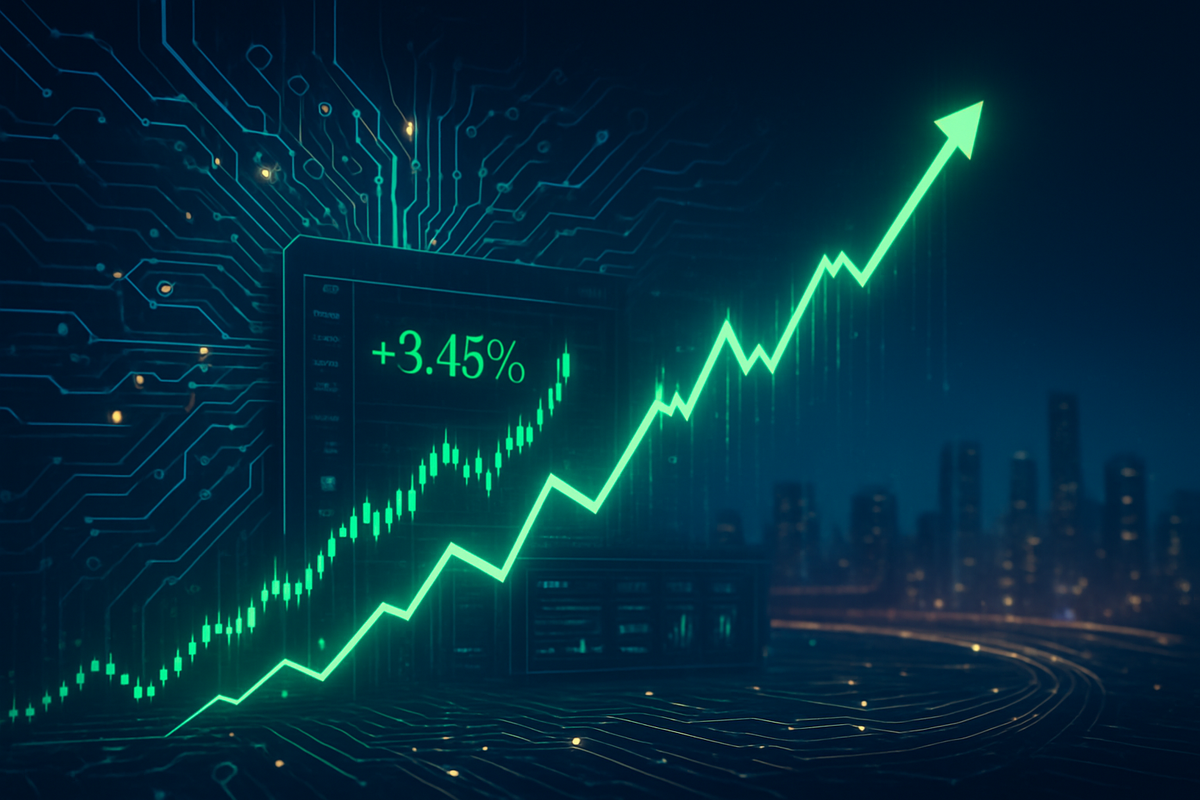
The financial markets witnessed a dramatic shift in sentiment over the final sessions of the week as a powerful two-day tech streak revitalized the Nasdaq and sparked a renewed debate over the return of growth-oriented investing. Following a period of jittery trading and a four-session slide, the technology sector roared back to life on December 18 and 19, 2025, driven by a combination of cooling inflation data and a resurgence in the artificial intelligence (AI) trade.
This sudden surge has immediate implications for the broader market, signaling that investors may be moving past the "higher-for-longer" interest rate anxiety that dominated the autumn months. With the Nasdaq Composite climbing over 2% across the 48-hour window and the S&P 500 nearing record highs, the rally suggests a growing confidence in a "soft landing" for the U.S. economy as it heads into 2026.
A Perfect Storm of Macro Relief and AI Momentum
The catalyst for this week’s dramatic turnaround was the release of the November Consumer Price Index (CPI) on the morning of Thursday, December 18. Headline inflation rose just 2.7% year-over-year, coming in significantly cooler than the 3.1% consensus estimate. Perhaps more importantly for tech investors, Core CPI—which strips out volatile food and energy costs—fell to 2.6%, its lowest level since early 2021. This data provided the necessary "green light" for the Federal Reserve to consider a more aggressive path of interest rate cuts in the coming year.
The timeline of the rally was bolstered by supportive commentary from Federal Reserve officials almost immediately following the data release. Chicago Fed President Austan Goolsbee noted that the cooling figures "opened the door" for further easing, while Governor Christopher Waller suggested that a softening labor market supports a measured approach to bringing rates down. This pivot in rhetoric shifted the market's focus from defensive positioning back to high-growth equities, which historically thrive when borrowing costs are expected to fall.
By Friday, December 19, the momentum was further complicated—but not deterred—by "triple-witching," the quarterly expiration of stock options, stock index futures, and stock index options. Despite the typical volatility and high trading volumes associated with this event, the tech sector held its ground. The Nasdaq Composite followed its 1.4% gain on Thursday with an additional 1.2% rise on Friday, effectively erasing the losses from earlier in the week and positioning growth stocks as the preferred vehicle for year-end "Santa Claus" rallies.
The Winners and Losers of the Growth Pivot
The "two-day streak" was not a rising tide that lifted all boats equally; rather, it highlighted a distinct preference for companies at the forefront of AI infrastructure and enterprise software. Micron Technology (NASDAQ: MU) emerged as the week’s standout performer. The memory chip giant saw its shares surge 10% on Thursday after delivering an earnings report that shattered expectations, followed by another 5.5% gain on Friday. Micron’s bullish outlook on AI-specific memory demand acted as a lightning rod for the entire semiconductor sector.
Oracle (NYSE: ORCL) also captured headlines, jumping 7.5% on Thursday and continuing its ascent with a 6.7% gain on Friday. The rally was fueled by reports that a joint venture involving Oracle and Silver Lake had reached a deal to acquire the U.S. operations of TikTok, a move that analysts believe will significantly boost Oracle’s cloud infrastructure business. Meanwhile, the "poster child" of the AI era, Nvidia (NASDAQ: NVDA), saw its shares climb roughly 6% over the two-day period as analysts reiterated "Buy" ratings, citing the company’s indispensable role in the global AI build-out.
However, the rotation back into tech growth left some traditional sectors and consumer-facing companies in the lurch. Nike (NYSE: NKE) was a notable detractor; despite a marginal earnings beat, its shares plummeted nearly 10% on Friday. Investors were spooked by a cautious outlook regarding sales in China and the looming threat of new tariffs, which could squeeze margins in 2026. Similarly, frozen-food leader Lamb Weston (NYSE: LW) saw its stock crater by 22% after failing to raise its full-year guidance, proving that the market’s current appetite is strictly reserved for companies showing clear, scalable growth.
Wider Significance and the Shift in Industry Trends
This two-day rally fits into a broader industry trend where "growth" is no longer just a speculative term but is increasingly backed by tangible infrastructure spending. The 2023-2024 AI hype cycle appears to be maturing into a 2025-2026 implementation phase. The fact that the market responded so aggressively to cooling CPI suggests that the primary headwind for tech—the cost of capital—is finally beginning to subside, allowing the fundamental earnings power of the "Magnificent Seven" and their peers to take center stage once again.
The ripple effects of this shift are being felt by competitors and partners alike. As Broadcom (NASDAQ: AVGO) and Advanced Micro Devices (NASDAQ: AMD) followed Nvidia and Micron higher, it became clear that the semiconductor industry is entering a new super-cycle driven by data center expansion. This has historical precedents, such as the mid-1990s internet build-out, but with a key difference: today’s tech leaders are highly profitable and sit on massive cash reserves, making them more resilient than the growth darlings of previous eras.
Furthermore, the regulatory landscape remains a critical variable. The Oracle-TikTok deal, if finalized, represents a significant shift in how tech giants navigate geopolitical tensions and national security concerns. As the U.S. government continues to balance trade restrictions with the desire for domestic tech dominance, companies that can successfully bridge these regulatory gaps are likely to see a "valuation premium" in the eyes of institutional investors.
What Comes Next: Strategic Pivots and Market Scenarios
In the short term, the market will be looking for confirmation that the "two-day streak" is more than just a technical bounce. The upcoming Q1 2026 earnings season will be the ultimate litmus test. Companies will need to prove that the massive capital expenditures (CapEx) seen in late 2024 and throughout 2025 are beginning to translate into bottom-line growth. If enterprise AI adoption continues at its current pace, the "growth-oriented" narrative could dominate the first half of 2026.
However, strategic pivots will be required. As interest rates begin their slow descent, the "easy money" of the past decade is unlikely to return in the same form. Investors are becoming more discerning, favoring "profitable growth" over "growth at any cost." This means that mid-cap tech firms and startups may face a challenging environment where they must demonstrate a clear path to profitability to attract the capital now flowing back into the sector.
Potential scenarios for the coming months range from a sustained bull market in tech to a period of "rolling corrections" as the market digests the impact of global trade policies. A key challenge will be the potential for renewed inflation if the labor market remains too tight, which could force the Federal Reserve to pause its planned rate cuts. Investors should prepare for increased volatility, especially as geopolitical tensions continue to influence supply chains and international sales.
Summary and Investor Outlook
The two-day tech streak of December 18-19, 2025, marks a significant moment in the current market cycle. By shaking off a multi-day slump and rallying on the back of favorable inflation data and strong AI-related earnings, the technology sector has reasserted its leadership position. The return to growth-oriented investing appears to be driven by a rare alignment of macroeconomic relief and fundamental technological shifts.
Moving forward, the market is likely to remain sensitive to any shifts in the Federal Reserve's stance and the ongoing evolution of the AI landscape. The key takeaways for investors are clear: quality growth remains the primary driver of alpha, but sensitivity to macro data and geopolitical risks like tariffs cannot be ignored. The "soft landing" remains the base case, but the margin for error is slim.
In the coming months, investors should keep a close watch on semiconductor lead times, enterprise software guidance, and any further commentary from Fed officials. While the two-day rally is an encouraging sign, the true test of this growth renaissance will be its durability in the face of the economic uncertainties that 2026 will inevitably bring.
This content is intended for informational purposes only and is not financial advice.