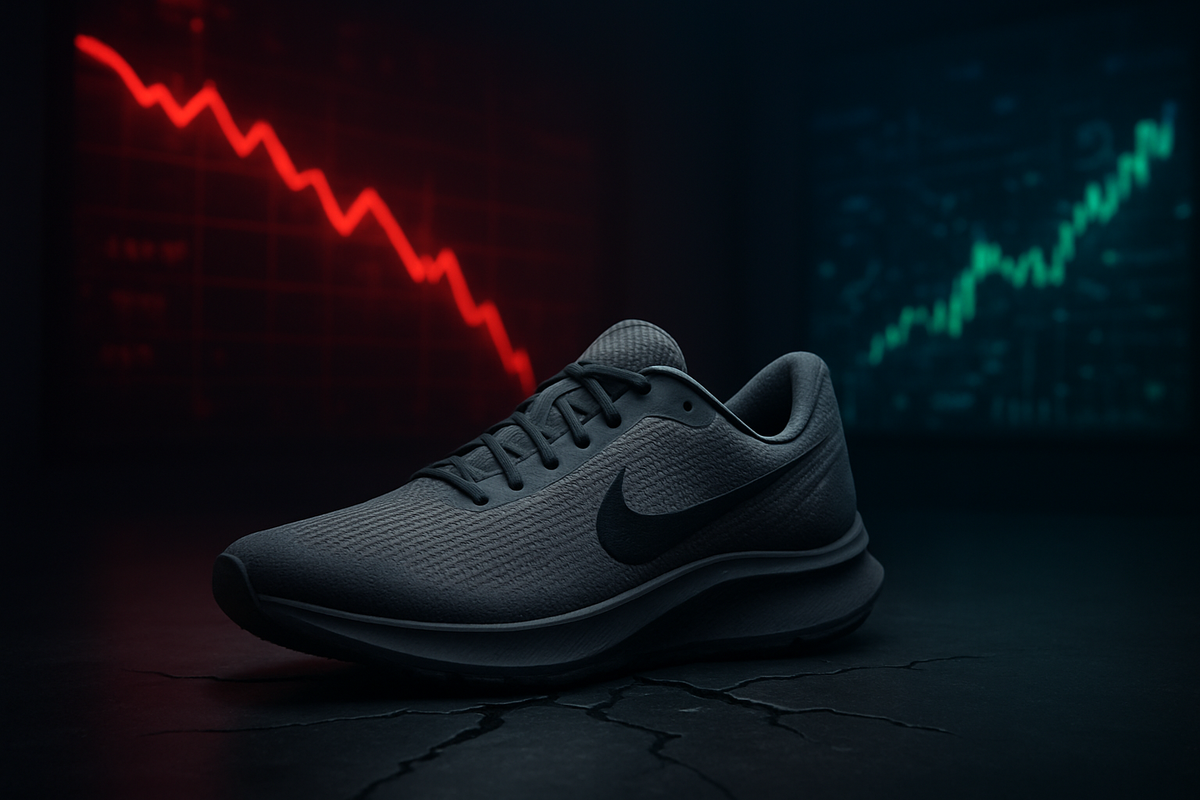
On a day when the broader market celebrated cooling inflation and a surge in artificial intelligence optimism, the world’s largest sportswear brand found itself on the outside looking in. On December 19, 2025, shares of Nike Inc. (NYSE: NKE) plummeted more than 10%, hitting a multi-year low of approximately $59.00 following a fiscal second-quarter earnings report that reignited fears over the company's long-term growth trajectory. The sharp decline effectively acted as an anchor on the Dow Jones Industrial Average, stripping nearly 45 points from the price-weighted index even as technology stalwarts like Nvidia (NASDAQ: NVDA) and Microsoft (NASDAQ: MSFT) pushed the average into positive territory.
The divergence highlights a growing rift in the 2025 market: while the "Magnificent Seven" and semiconductor leaders continue to ride the AI wave to record highs, legacy consumer discretionary brands are grappling with a "perfect storm" of geopolitical friction and shifting consumer loyalties. For Nike, the day’s double-digit slide isn't just a reaction to a single quarter; it is a stark realization for investors that the "Swoosh" is in the midst of a painful, protracted turnaround that shows few signs of an immediate finish line.
A Quarter of Contradictions: Inside the December 19 Sell-Off
The catalyst for Friday’s sell-off was a fiscal second-quarter earnings report that was a study in contradictions. On paper, Nike managed to beat earnings-per-share estimates, posting $0.53 against a consensus of $0.38. However, the market looked past the bottom-line beat to focus on a grim revenue outlook and a staggering 300 basis point contraction in gross margins. The company’s warning that it expects a low-single-digit revenue decline in the coming quarter, coupled with the announcement that 2025 U.S. tariffs could cost the company upwards of $1.5 billion, sent investors rushing for the exits.
The timeline leading to this moment has been one of structural transition. Since Elliott Hill took the helm as CEO in October 2024, the company has been aggressively dismantling the "Consumer Direct Acceleration" strategy of his predecessor, John Donahoe. Hill, a 32-year Nike veteran, was brought out of retirement to restore the brand’s focus on performance innovation and wholesale partnerships. However, the December 19 report suggests that the "vacuum" created on retail shelves during the previous administration's pivot to direct-to-consumer (DTC) sales has been more difficult to reclaim than anticipated. While North American wholesale grew 24% in the latest quarter, it was not enough to offset an 8% slide in Nike Direct sales and a catastrophic 17% decline in Greater China.
The situation in China remains the most significant thorn in Nike’s side. Once the company's primary growth engine, the region has now reported its sixth consecutive quarterly decline. Local Chinese brands have capitalized on rising nationalism and a sluggish economy, offering high-quality alternatives at lower price points. Nike’s attempt to combat these headwinds with "surgical price increases" of roughly 17% to offset tariff costs appears to have backfired, testing the limits of brand loyalty in its most critical international market.
Winners and Losers: The Shifting Footwear Hierarchy
As Nike struggles to find its footing, the competitive landscape has fundamentally shifted. The primary beneficiaries of Nike’s "innovation gap" have been specialized, "maximalist" running brands. Deckers Brands (NYSE: DECK), the parent company of Hoka, has seen its market share in the performance running category swell throughout 2025. While Hoka’s growth has moderated from its triple-digit peaks, it remains the preferred choice for serious runners and healthcare professionals alike, a demographic Nike once dominated.
Similarly, On Holding (NYSE: ONON) has successfully leveraged a community-centric marketing model to capture the Gen Z and Millennial demographics. Analysts note that while Nike remains the largest player by volume, On has captured the "cultural zeitgeist," with its sleek designs and premium positioning. In the lifestyle segment, Adidas (XETRA: ADS) has staged a significant comeback in 2025, driven by the enduring popularity of its "Terrace" footwear models like the Samba and Gazelle, which have crowded out Nike’s aging Dunk and Jordan 1 franchises on city streets.
The pain is also being felt by traditional retail partners, though the impact is nuanced. While Foot Locker (NYSE: FL) and JD Sports (LSE: JD) have welcomed Nike’s return to a wholesale-first strategy, the overall weakness in the Nike brand—which often accounts for more than 60% of their inventory—has pressured their own stock prices. Conversely, JPMorgan Chase (NYSE: JPM) and other financial institutions have seen their shares rise as they benefit from the broader market's "risk-on" sentiment, effectively insulating the Dow from Nike's specific consumer-sector woes.
Broader Significance: Tariffs, Trends, and the Innovation Trap
Nike’s current predicament is a bellwether for the broader consumer discretionary sector as it enters 2026. The company’s warning regarding $1.5 billion in tariff-related costs is one of the most explicit acknowledgments to date of how shifting U.S. trade policies are impacting global supply chains. For years, Nike’s high-margin model relied on seamless global trade; the 2025 environment of "surgical price increases" and supply chain re-routing represents a fundamental shift in the cost of doing business.
Furthermore, the "Swoosh Slump" highlights the dangers of the "Innovation Trap." By prioritizing its digital apps and lifestyle sneakers over the last four years, Nike allowed its core performance technology to stagnate. This event serves as a cautionary tale for other legacy giants like Starbucks (NASDAQ: SBUX) or Disney (NYSE: DIS), illustrating how quickly a dominant brand can lose its "cool factor" when it loses touch with its core product's functional purpose.
Historically, Nike has navigated downturns before—most notably in the late 1990s when it struggled to pivot away from basketball dominance toward the burgeoning "brown shoe" and hiking trends. However, the 2025 landscape is far more fragmented. The rise of niche brands and the speed of social-media-driven trend cycles mean that Nike can no longer rely on its massive marketing budget alone to reclaim the top spot.
What Comes Next: The "Middle Innings" of a Comeback
CEO Elliott Hill has been candid about the road ahead, describing the company as being in the "middle innings" of its turnaround. In the short term, investors should expect further volatility as Nike continues to clear excess inventory through heavy discounting, which will likely keep gross margins under pressure through the first half of 2026. The company is also expected to continue its "C-suite reset," further streamlining its organization to increase agility and integrate digital capabilities directly into its supply chain.
The long-term success of the "Win Now" strategy hinges on the 2026 product pipeline. Nike has teased a "new era of cushioning" and a revamped running lineup aimed at reclaiming the marathon and 5K circuits from Hoka and On. If these products fail to resonate with the core athlete, Nike may be forced to consider more radical strategic pivots, including potential divestitures of non-core sub-brands or a more aggressive restructuring of its global footprint.
Summary and Investor Outlook
The events of December 19, 2025, mark a significant chapter in the history of one of the world’s most iconic brands. While the broader market finds strength in technology and financials, Nike remains a stark reminder of the challenges facing global retailers in an era of geopolitical tension and hyper-competition.
Key Takeaways for Investors:
- The China Factor: Until Nike can stabilize its performance in Greater China, the stock will likely face a ceiling, regardless of North American wholesale growth.
- Tariff Elasticity: Watch for how consumers react to the 17% price hikes; if demand craters, Nike’s margin contraction could worsen.
- Innovation as a Catalyst: The 2026 product launches are the ultimate "make or break" moment for Elliott Hill’s leadership.
For now, the Dow may have found a way to rally without its footwear giant, but the market will be watching closely to see if the "Swoosh" can eventually find its stride again, or if it will continue to serve as the index's heaviest anchor.
This content is intended for informational purposes only and is not financial advice.