Most businesses do not have a footage shortage.
They have product demonstrations, webinar recordings, founder videos, customer interviews, training sessions, event coverage, podcasts, sales calls, and unfinished campaign material. The footage exists, but much of it remains scattered across cloud drives, employee laptops, messaging platforms, and abandoned editing projects.
The problem is economic rather than creative.
Recording another video may take an hour. Finding the useful material, cutting it into a coherent story, adding captions, sourcing supporting footage, resizing it for multiple platforms, and securing approval can take days.
That imbalance leaves companies sitting on a growing inventory of content they have already paid to produce but cannot efficiently use.
An AI video editor changes that calculation by reducing the work required to understand, organize, edit, and repurpose existing footage. The opportunity is not simply to make video production cheaper. It is to extract more business value from assets that would otherwise remain unused.
The Hidden Cost of Unused Business Footage
Every recording carries a production cost, even when no formal production budget exists.
Employees spend time preparing for interviews. Product managers record demonstrations. Executives participate in webinars. Marketing teams arrange customer conversations. Events require travel, equipment, coordination, and access to speakers.
Once that material is recorded, however, its value depends on whether the company can turn it into something useful.
A 45-minute webinar might contain a strong two-minute product explanation, three customer objections worth answering, several short social clips, and material for a sales enablement video. If nobody reviews and edits the recording, all of that value remains locked inside one long file.
The traditional response has been to send footage to an editor with a detailed brief. That works for planned campaigns, but it becomes expensive and slow when every department is producing recordings continuously.
The result is a widening gap between the amount of footage businesses capture and the amount they publish.
Video Should Be Treated as an Asset
Businesses often treat a completed video as a fixed deliverable.
A webinar becomes a webinar. A customer interview becomes one case study. A product recording becomes one tutorial. After publication, the source footage is archived and rarely revisited.
That model made sense when every new edit required substantial manual work. It makes less sense when transcripts, automated footage analysis, generative media, and editable timelines can help teams reconstruct existing material for new purposes.
The more useful model is to treat every recording as a collection of reusable components:
● Spoken explanations
● Product visuals
● Customer statements
● Demonstrations
● Founder commentary
● Questions and answers
● Supporting examples
● Short hooks and conclusions
One recording can support multiple campaigns when those components are searchable and editable. Its economic value no longer depends on the performance of one published video.
How an AI Video Editor Changes the Cost Structure
Traditional editing cost increases with the amount of footage an editor must inspect.
A person may need to watch an entire interview before identifying the relevant sections. They then cut the footage, remove repetitions, arrange the narrative, add captions, and search for supporting visuals.
AI-assisted editing reduces the time spent on the mechanical parts of that process.
A transcript can make spoken footage searchable. Text-based editing can connect sentences directly to the corresponding video frames. Automated silence removal can clean a rough recording before detailed editing begins. Captions, reframing, and initial content selections can be prepared without rebuilding each version manually.
This does not eliminate the need for editorial judgment. Someone still needs to decide what the video should communicate, which claims matter, and whether the final piece represents the brand accurately.
The financial change comes from applying human judgment later in the process, after the most repetitive work has already been reduced.
The Biggest Gain Comes From Repurposing
Generating a completely new video attracts more attention, but repurposing existing material often produces the clearer business return.
New production introduces new costs. The team needs a concept, script, speaker, recording session, equipment, and approval before editing with prompts can begin.
Repurposing starts with material the company already owns.
A business can turn one customer interview into a case-study video, several testimonial clips, a sales presentation insert, an onboarding example, and short social posts. A product webinar can become a feature walkthrough, an FAQ series, a launch recap, and multiple captioned clips.
The marginal cost of each additional asset falls because the underlying footage, speakers, and message have already been captured.
That is where AI video editing becomes an operational system rather than an occasional creative tool.
One Recording Can Serve Several Business Functions
The same footage can create value across different departments when teams stop treating video as a marketing-only format.
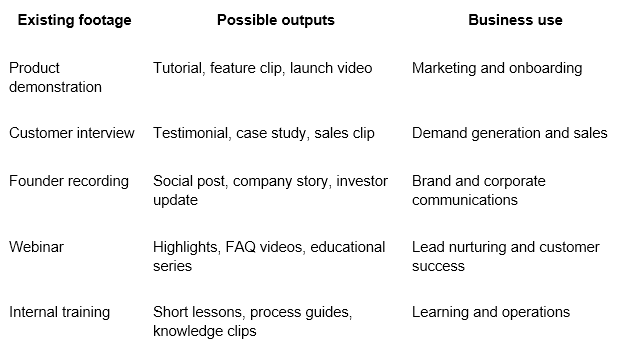
The limiting factor is rarely whether the original recording contains useful information. It is whether the company has a workflow for finding and adapting it.
Editable Output Matters More Than One-Click Generation
A fully generated video can look impressive in a demonstration and still be difficult to use in a real campaign.
Businesses need to change claims, adjust pacing, replace visuals, follow brand standards, and respond to legal or stakeholder feedback. A video that cannot be edited precisely may save time during generation but add it back during revision.
That makes editability a central requirement.
The strongest business workflow combines AI assistance with a conventional editing structure. The software can help interpret instructions, find relevant moments, assemble a draft, and automate repetitive tasks. The user should still be able to inspect the timeline and change individual elements.
This balance is particularly important for product videos, customer stories, financial communications, and other material where accuracy matters more than novelty.
Content Volume Changes the Investment Decision
Not every organization needs the same level of video infrastructure.
A company publishing four major videos per year may continue to rely on an external production partner. A team producing daily social content, weekly product updates, monthly webinars, and localized campaign versions faces a different calculation.
As output volume rises, small inefficiencies compound.
If preparing each video requires repeated file transfers, transcript creation, manual clip selection, captioning, formatting, and stakeholder handoffs, the workflow becomes the constraint. Hiring more editors can increase capacity, but it does not fix an inefficient production system.
AI-assisted editing delivers the strongest return when a company has:
● A growing archive of recorded material
● Regular demand for short-form video
● Several channels requiring different formats
● Frequent product or campaign updates
● Limited editing capacity
● Repeated requests to repurpose long recordings
At that point, the question is not whether one video becomes cheaper. It is how many additional usable assets the same team can produce.
The Video Editor’s Role Is Becoming More Strategic
Automation does not remove the need for editors. It changes where their time is most valuable.
Editors create the most value through narrative structure, pacing, visual judgment, sound, brand consistency, and an understanding of what the audience needs. Searching through recordings, removing long pauses, producing first-pass captions, and resizing routine versions are necessary tasks, but they are not the highest-value use of specialist time.
When software handles more preparation, editors can focus on the decisions that determine quality.
Marketing teams also gain more independence. They can prepare rough cuts, test different hooks, and organize footage before asking a specialist to complete the final treatment. That reduces avoidable back-and-forth without lowering the standard of the finished work.
Businesses Need a Content Inventory Before Buying More Production
The immediate response to weak video output is often to commission more footage.
For many companies, the better first step is an inventory.
Teams should identify what has already been recorded, where it is stored, who owns it, and whether the company has permission to reuse it. The review should include webinars, meetings, product walkthroughs, customer interviews, events, podcasts, founder recordings, and unfinished projects.
Each file can then be classified by topic, speaker, audience, product, and potential format.
This exercise often reveals that the company already has enough material for months of content. What it lacks is a repeatable system for converting that material into publishable assets.
The Business Case Is Utilization, Not Automation
The strongest argument for AI video editing is not that software can replace an editor or create a video instantly.
It is that businesses can use more of what they already own.
A recording that produces one asset has limited value. A recording that supports several campaigns, platforms, languages, and stages of the customer journey has a much higher return.
That shifts video budgeting away from isolated production projects and toward a persistent content pipeline. Capture remains important, but organization, editability, and reuse determine how much value the business ultimately receives.
The next productivity gain in video will not come from recording everything again. It will come from finally using the material that has already been recorded.
Frequently Asked Questions
What is an AI video editor?
An AI video editor uses capabilities such as transcription, content analysis, automated clip selection, captioning, and instruction-based editing to reduce manual production work. The best tools keep the output editable so users can refine the timeline and final presentation.
Can AI edit existing business footage?
Yes. Existing webinars, interviews, demonstrations, podcasts, and founder recordings can be transcribed, searched, cut, captioned, and reorganized into new videos. Results depend on recording quality and the clarity of the intended message.
Does AI video editing replace professional editors?
No. It reduces repetitive preparation and basic editing tasks. Professional editors remain important for narrative decisions, advanced finishing, brand judgment, audio quality, and high-value campaign work.
What businesses benefit most from AI video editing?
The strongest fit is with businesses that record frequently, publish across several channels, produce large amounts of short-form content, or need to create multiple versions from the same footage.
How should a company begin repurposing its video archive?
Start by cataloging recordings according to subject, speaker, audience, product, and usage rights. Select one high-value recording and turn it into several defined outputs. Use the result to build a repeatable workflow before processing the wider archive.