

New book explores love, sacrifice, and humanity's fight for survival after the sun's disappearance plunges Earth into darkness
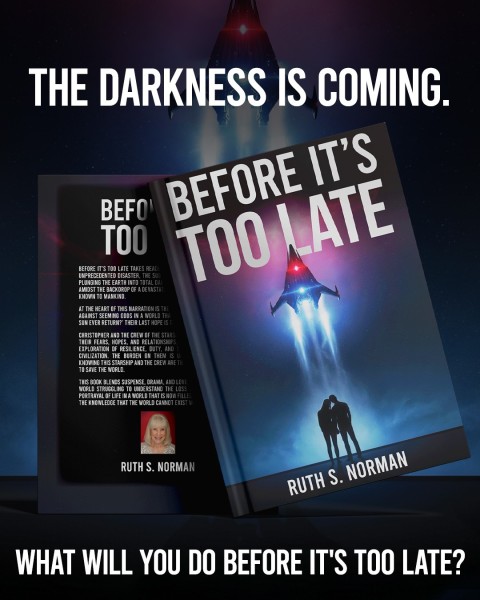
ORLANDO, FL – Author Ruth S. Norman will release "Before It's Too Late," a sci-fi romance novel, in February 2026. The book explores how scientific, political, and civilian sectors respond when the sun disappears without explanation, leaving Earth in permanent darkness, while at its heart telling a powerful story of love tested by global catastrophe. Norman dedicated the work to her mother's memory and her children: Michael, Keith, Donna, Andrew, and Sherry.
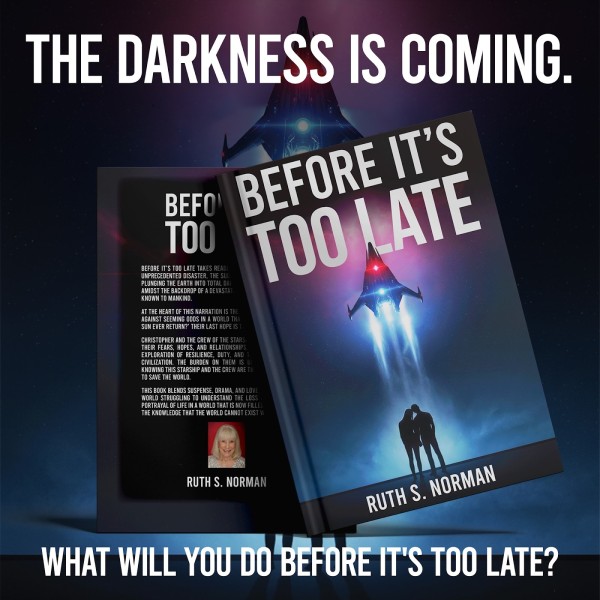
The story follows Christopher Bennett, an aeronautics engineer who designed the Starship Phoenix for deep space exploration. After the sun vanishes in July 2029, Bennett must decide whether to join the Phoenix crew on a mission to investigate the phenomenon or remain with the woman he loves as society begins to collapse around them. His personal conflict between duty and devotion becomes central to the narrative.
Norman began developing the concept 20 years ago following an observation of unusual atmospheric conditions during a morning walk on a Fort Lauderdale beach. The author spent two decades researching astrophysics and aerospace engineering to incorporate technical depth into the story while maintaining its emotional core.
"The book examines how people respond when both the world and their personal lives are turned upside down," Norman said. "It includes scientists searching for answers, government officials coordinating responses, and ordinary people trying to hold onto love and hope as everything familiar disappears."
The novel alternates between locations in Florida and Washington, D.C., including Kennedy Space Center, Orlando, Cocoa Beach, and government facilities. The story includes multiple perspectives: a limousine driver witnessing the collapse of Orlando's tourism industry, national leaders confronting unprecedented decisions, and scientists briefing officials about magnetic field disturbances, all set against the evolving relationship at the center of the story.
Norman incorporated scientific concepts related to Earth's magnetosphere, astrophysics, and space exploration technology. The author researched how spacecraft operate within magnetic fields and the potential challenges of traveling through disturbed atmospheric conditions, grounding the romance within a scientifically credible scenario.
The book addresses how social systems and personal relationships respond under extreme pressure. The narrative depicts the closure of theme parks, food shortages, rising unrest, and government efforts to maintain order, while also exploring how love, faith, and resilience endure even in prolonged darkness. Norman set scenes at recognizable Florida locations to establish realism and emotional connection.
"The research process involved understanding both the science of what could happen to Earth without sunlight and how human relationships would be affected by that reality," Norman said. "The technical elements support the story, but the heart of the novel is about love and sacrifice."
Norman structured "Before It's Too Late" as the first volume in a planned series. This installment concludes with preparations for the Phoenix mission, setting the stage for subsequent volumes that will follow the crew's journey into space and the continuing emotional stakes left behind on Earth.
The book will be available in three formats with the following ISBNs: paperback (979-8-90224-019-8), hardback (979-8-90224-020-4), and eBookPre-Launch (979-8-90224-018-1). The novel falls within the sci-fi romance genre, combining apocalyptic science fiction with themes of enduring love, sacrifice, and human resilience.
About the Author
Ruth S. Norman is an accomplished author with a vivid imagination and a passion for storytelling that began in childhood. Her ability to blend scientific depth with emotional storytelling allows her to craft narratives that are both intellectually engaging and deeply human. Norman resides in Florida, where the inspiration for "Before It's Too Late" first struck two decades ago.