Massachusetts-based BXP, Inc. (BXP), formerly Boston Properties, is the largest publicly traded developer, owner, and operator of high-quality workplace properties in the United States, with a presence across six major gateway markets: Boston, Los Angeles, New York, San Francisco, Seattle, and Washington, D.C. With a track record spanning more than five decades, the company has focused on building and managing office environments that support business activity and urban growth.
Structured as a real estate investment trust (REIT), BXP operates as a fully integrated real estate platform, handling development, leasing, and property management. Mid-cap companies are typically valued between $2 billion and $10 billion, and at a market capitalization of roughly $9.4 billion, BXP falls at the higher end of this bracket.
As of Dec. 31, 2025, the company’s portfolio, including assets held through unconsolidated joint ventures, comprised approximately 52.6 million square feet across 179 properties, with eight additional properties under construction or redevelopment. However, despite this strong footprint, the company’s share performance has been less than stellar so far.
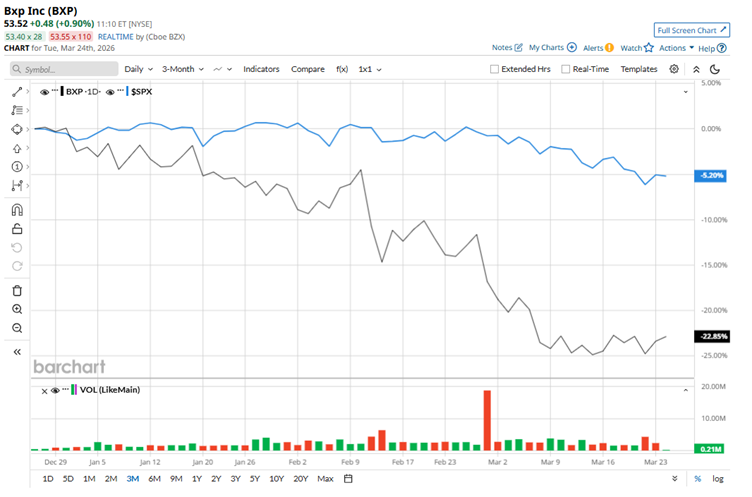
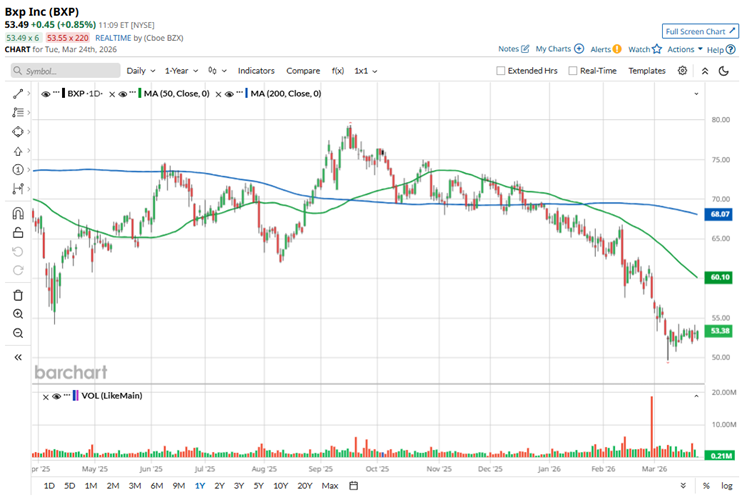
After climbing to a 52-week high of $79.33 last September, the shares have since lost significant ground, tumbling 33.1% from that peak. The recent trend has been equally challenging. Over the past three months alone, the stock has dropped nearly 23.4%, sharply underperforming the broader market, with the S&P 500 Index ($SPX) slipping only about 5% over the same period.
The longer-term picture doesn’t offer much relief either. Over the past year, BXP shares have declined nearly 23.7%, underperforming the broader market, with the S&P 500 delivering a solid 13.6% gain over the same period. The technical picture has remained weak as well. Since late December, the stock has consistently traded below both its 50-day and 200-day moving averages, a clear sign of sustained bearish momentum and continued selling pressure.
BXP’s latest earnings release painted a mixed picture that left investors unconvinced. Following its Jan. 27 report for the fiscal 2025 fourth quarter, the stock slipped 1.6% in the next trading session. While top-line growth offered a modest positive, it wasn’t enough to offset broader concerns. Revenue rose 2.2% year over year to $877.1 million, but adjusted revenue of $809.2 million came in below Wall Street expectations of $814.7 million.
More importantly for a REIT, funds from operations (FFO), a key industry metric, also disappointed. BXP reported FFO of $1.76 per share, missing the $1.80 estimate and declining from $1.79 in the same quarter last year. The combination of soft misses and slowing FFO momentum underscored the challenges facing the company, keeping investor sentiment in check.
While BXP has lagged the broader market, its struggles are not unique within the sector. Industry peer Alexandria Real Estate Equities, Inc. (ARE) has fared even worse, with its shares plunging nearly 50.7% over the past year, significantly underperforming BXP.
Nevertheless, Wall Street’s stance on BXP reflects cautious optimism. Of the 23 analysts covering the stock, the consensus rating sits at a “Moderate Buy,” signaling a measured yet constructive outlook. Importantly, the upside potential remains notable. The average price target of $71.75 implies a roughly 34.1% gain from current levels, suggesting that despite recent weakness, analysts see meaningful room for recovery if fundamentals stabilize.
On the date of publication, Anushka Mukherjee did not have (either directly or indirectly) positions in any of the securities mentioned in this article. All information and data in this article is solely for informational purposes. For more information please view the Barchart Disclosure Policy here.
More news from Barchart