

Growing regulatory mandates, circular economy commitments, and textile waste recovery infrastructure accelerate market expansion.
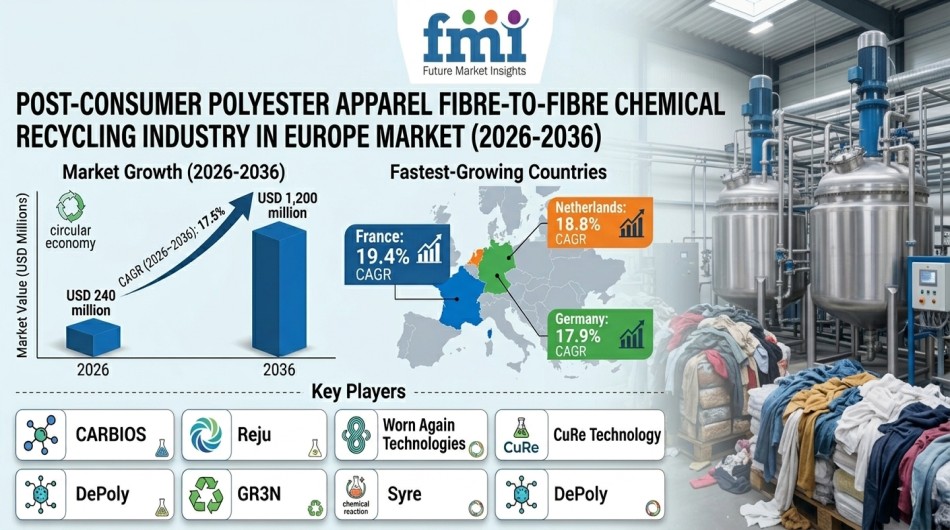
NEWARK, DE / ACCESS Newswire / April 3, 2026 / The Europe post-consumer polyester apparel fibre-to-fibre chemical recycling market is poised for rapid expansion over the next decade, growing from USD 200 million in 2025 to USD 1,200 million by 2036, registering a robust CAGR of 17.5%. According to the latest analysis by Future Market Insights, demand is being driven by stringent textile waste regulations, extended producer responsibility (EPR) frameworks, and increasing adoption of circular textile manufacturing systems across Europe.
Post-Consumer Polyester Apparel Fibre-to-Fibre Chemical Recycling Industry in Europe Market Snapshot (2026-2036)
Market size in 2026: USD 240 million
Market size in 2036: USD 1,200 million
CAGR (2026-2036): 17.5%
Leading technology: Glycolysis (~38% share)
Dominant feedstock: Mono-material garments (~41% share)
Key growth region: Western and Southern Europe
Fastest-growing countries: France (19.4%), Netherlands (18.8%), Germany (17.9%)
Get Access of Report Sample: https://www.futuremarketinsights.com/reports/sample/rep-gb-32556
Market Momentum
The market begins at USD 200 million in 2025 and grows steadily to USD 240 million in 2026, supported by early-stage investments and pilot-scale deployments. By 2030, accelerated enforcement of textile collection mandates and brand-led sustainability commitments significantly increase demand for fibre-to-fibre recycled polyester.
Between 2030 and 2036, large-scale commercialization of depolymerization technologies, expansion of municipal textile sorting infrastructure, and integration with chemical parks drive exponential growth. By 2036, the market reaches USD 1,200 million, sustaining a strong 17.5% CAGR.
Why the Market Is Growing
The industry is expanding rapidly due to increasing pressure on apparel brands to meet circularity targets and reduce reliance on virgin polyester. Regulatory frameworks mandating separate textile waste collection across Europe are forcing large-scale diversion of garments from landfills and incineration.
Chemical recycling technologies enable true fibre-to-fibre circularity by converting end-of-life polyester into virgin-equivalent raw materials. This capability is critical for performance textiles such as sportswear, where mechanical recycling fails to meet durability and quality standards.
At the same time, corporate sustainability initiatives are encouraging premium pricing for chemically recycled fibres, further strengthening market economics.
Segment Spotlight
Technology: Glycolysis Leads with ~38% Share
Glycolysis dominates due to lower energy requirements and compatibility with existing PET processing infrastructure. Its ability to produce high-quality monomers makes it the preferred route for textile-to-textile recycling.
Feedstock: Mono-Material Garments (~41% Share)
Mono-material polyester garments lead due to predictable yields and simplified processing, eliminating the need for complex separation technologies.
Output Form: Recycled PET Chips (~36% Share)
Recycled PET chips remain the preferred output format, offering seamless integration into existing fibre-spinning facilities.
Application: Sportswear (~34% Share)
Sportswear dominates demand due to stringent performance requirements that only chemically recycled fibres can meet.
Scale Stage: Pilot Plants (~44% Share)
Pilot-scale facilities dominate as companies validate technologies before transitioning to full-scale commercial operations.
Regional Growth: Europe Drives Expansion
Western Europe leads market growth through integrated chemical recycling hubs and strong regulatory backing, while Southern Europe leverages legacy textile manufacturing infrastructure to scale operations.
France emerges as the fastest-growing market, supported by government-backed recycling infrastructure investments. The Netherlands benefits from integration within existing chemical clusters, while Germany focuses on energy-efficient recycling technologies.
Drivers, Opportunities, Trends, Challenges
Drivers:
Mandatory textile waste collection regulations
Extended producer responsibility (EPR) frameworks
Rising demand for sustainable apparel
Opportunities:
Enzymatic depolymerization technologies
Elastane separation innovations
Dope-dyeing integration for waterless processing
Trends:
Vertical integration with sorting infrastructure
Growth of closed-loop textile systems
Increased collaboration between brands and recyclers
Challenges:
Sorting inefficiencies and feedstock contamination
High capital investment requirements
Limited large-scale commercial infrastructure
Country Growth Outlook (2026-2036)
Country |
CAGR |
France |
19.4% |
Netherlands |
18.8% |
Germany |
17.9% |
Switzerland |
17.6% |
Italy |
16.8% |
Spain |
16.1% |
Belgium |
15.7% |
Analyst Commentary
Nikhil Kaitwade, Principal Analyst at Future Market Insights, notes that:
"While capacity announcements remain strong, actual plant utilization is constrained by inadequate textile sorting infrastructure. Investors focusing solely on chemical innovation often underestimate the importance of feedstock aggregation and reverse logistics in achieving commercial viability."
Competitive Landscape
The market is characterized by emerging technology providers and collaborative ecosystems involving apparel brands, recyclers, and municipal authorities. Competitive advantage is increasingly determined by access to high-quality feedstock and long-term off-take agreements rather than standalone technological capabilities.
Key Players in the Market
CARBIOS
Reju
Worn Again Technologies
CuRe Technology
DePoly
GR3N
Syre
For an in-depth analysis of evolving formulation trends and to access the complete strategic outlook for the Post-Consumer Polyester Apparel Fibre-to-Fibre Chemical Recycling Industry in Europe Market through 2036, visit the official report page at: https://www.futuremarketinsights.com/reports/post-consumer-polyester-apparel-fibre-to-fibre-chemical-recycling-industry-in-europe
Explore More Related Studies Published by FMI Research:
Integrated Fuel Filter Modules Market: https://www.futuremarketinsights.com/reports/integrated-fuel-filter-modules-market
Composite Airframes Market: https://www.futuremarketinsights.com/reports/composite-airframes-market
Icephobic Nano Coatings for Aircraft Market: https://www.futuremarketinsights.com/reports/icephobic-nano-coatings-for-aircraft-market
Bio-based Aircraft Coatings Market: https://www.futuremarketinsights.com/reports/bio-based-aircraft-coatings-market
Bamboo Market: https://www.futuremarketinsights.com/reports/bamboos-market
About Future Market Insights (FMI)
Future Market Insights (FMI) is a leading provider of market intelligence and consulting services, serving clients in over 150 countries. Headquartered in Delaware, USA, with a global delivery center in India and offices in the UK and UAE, FMI delivers actionable insights to businesses across industries including automotive, technology, consumer products, manufacturing, energy, and chemicals.
An ESOMAR-certified research organization, FMI provides custom and syndicated market reports and consulting services, supporting both Fortune 1,000 companies and SMEs. Its team of 300+ experienced analysts ensures credible, data-driven insights to help clients navigate global markets and identify growth opportunities.
For Press & Corporate Inquiries
Rahul Singh
AVP - Marketing and Growth Strategy
Future Market Insights, Inc.
+91 8600020075
For Sales - sales@futuremarketinsights.com
For Media - Rahul.singh@futuremarketinsights.com
For web - https://www.futuremarketinsights.com/
SOURCE: Future Market Insights, Inc.
View the original press release on ACCESS Newswire