Thermoformed fibre is evolving into a premium, high-performance packaging material, driven by sustainability mandates, foodservice growth, and advanced fiber-forming technologies.
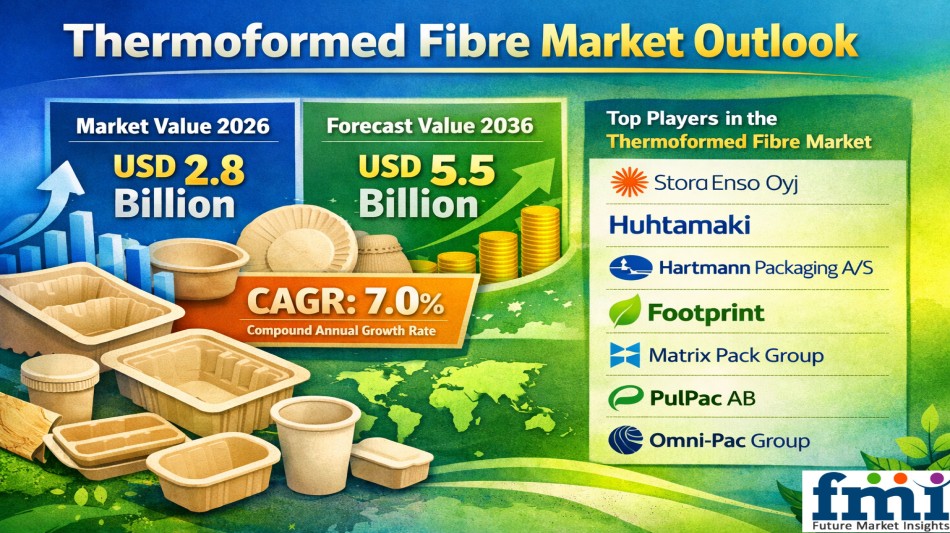
NEWARK, DE / ACCESS Newswire / April 1, 2026 / The global thermoformed fibre market is entering a decisive growth phase, transforming from a niche sustainable packaging alternative into a mainstream, premium packaging solution. Valued at USD 2.6 billion in 2025, the market is projected to reach USD 2.8 billion in 2026 and surge to USD 5.5 billion by 2036, expanding at a CAGR of 7.0% over the forecast period.
This growth signals a structural shift in packaging priorities: thermoformed fibre is no longer just about sustainability-it is increasingly viewed as a high-performance material delivering both environmental compliance and premium consumer experience.
According to the latest strategic analysis by Future Market Insights (FMI), the market's expansion is being fueled by the convergence of sustainability mandates, foodservice transformation, and advancements in fiber-forming technologies that enable superior aesthetics and functional precision.
Thermoformed Fibre Market Snapshot (2026-2036)
Metric |
Value |
Market Value (2025) |
USD 2.6 Billion |
Market Value (2026) |
USD 2.8 Billion |
Forecast Value (2036) |
USD 5.5 Billion |
CAGR (2026-2036) |
7.0% |
Leading Fiber Source |
Virgin Wood Pulp (46.1%) |
Leading Product Type |
Plates & Bowls (24.7%) |
Leading End Use |
Foodservice (39.2%) |
Discover Growth Opportunities in the Market - Get Your Sample Report Now
https://www.futuremarketinsights.com/reports/sample/rep-gb-32521
The Material Evolution: From Molded Utility to Premium Performance
The thermoformed fibre market is undergoing a "materiality upgrade," transitioning from traditional molded pulp applications to high-definition, thin-wall packaging formats. Unlike conventional fiber products, thermoforming enables smoother surfaces, sharper contours, and tighter dimensional tolerances-qualities that are increasingly demanded in consumer-facing applications.
Manufacturers are investing heavily in advanced forming technologies and high-quality fiber inputs to meet evolving brand expectations. Virgin wood pulp is expected to dominate the fiber source segment, accounting for 46.1% of demand in 2026, owing to its superior strength, consistency, and finish quality.
"Thermoformed fiber sits where aesthetics and sustainability finally meet," notes Ismail Sutaria, Senior Consultant at FMI. "The category is gaining traction because it delivers a cleaner shelf presence and enhanced tactile experience while maintaining strong recyclability credentials."
This transition is redefining cost structures across the value chain. While production costs are higher compared to traditional molded pulp, the ability to command premium pricing through enhanced product differentiation is reshaping profitability dynamics.
Tableware Transformation: The Demand Engine
One of the most significant growth catalysts is the rapid substitution of plastic and foam-based tableware with fiber-based alternatives. Thermoformed fibre products-particularly plates, bowls, trays, and clamshells-are benefiting from large-scale adoption across foodservice and takeaway ecosystems.
Plates and bowls are projected to remain the leading product segment, capturing 24.7% of the market share in 2026. Their standardized formats, high-volume consumption patterns, and ease of adoption make them the cornerstone of thermoformed fibre demand.
Simultaneously, the expansion of ready-to-eat meals, online food delivery, and dine-away formats is driving increased consumption of clamshells, meal trays, and lids. These applications demand packaging that not only protects food but also enhances presentation-an area where thermoformed fibre excels.
Foodservice Dominance: A High-Volume Opportunity
The foodservice industry continues to be the primary end-use segment, expected to account for 39.2% of total demand in 2026. The sector's reliance on disposable packaging for takeaway meals, airline catering, and event dining creates a high-volume, repeat-use environment ideally suited for thermoformed fibre solutions.
Operators are increasingly prioritizing packaging that offers:
Improved stackability and storage efficiency
Enhanced visual appeal for consumer-facing applications
Compatibility with sustainability regulations and waste reduction targets
These factors are accelerating the shift toward thermoformed fibre as a preferred packaging format across global foodservice networks.
Regulatory Alignment: Sustainability as a Market Catalyst
Global regulatory frameworks aimed at reducing plastic waste are playing a pivotal role in shaping the thermoformed fibre market. Governments and environmental agencies are promoting materials that support circular economy principles, including recyclability and compostability.
Thermoformed fibre aligns strongly with these requirements, offering a viable alternative to fossil-based packaging materials. This regulatory tailwind is particularly strong in regions such as Europe and North America, where stringent packaging laws are accelerating the adoption of fiber-based solutions.
At the same time, emerging economies are integrating sustainability into their packaging ecosystems, creating new growth opportunities for thermoformed fibre manufacturers.
Technology and Innovation: Redefining Performance Standards
Technological advancements in thermoforming processes are unlocking new application possibilities. Heat-pressed molding techniques are enabling manufacturers to achieve:
Higher surface smoothness and finish quality
Improved dimensional consistency for better lid fit and sealing
Enhanced durability for handling and transportation
These innovations are expanding the use of thermoformed fibre beyond traditional tableware into areas such as fresh produce packaging, consumer electronics inserts, and healthcare applications.
However, challenges remain. Barrier performance in wet or greasy food applications continues to require coatings or hybrid structures, which can complicate recycling processes and increase production complexity.
Market Segmentation: Expanding Application Horizons
The thermoformed fibre market is diversifying across multiple dimensions:
By Fiber Source:
Virgin wood pulp
Recycled pulp
Bagasse
Bamboo
Others
By Product Type:
Plates and bowls
Clamshells
Meal trays
Lids
Industrial trays
Others
By End Use Industry:
Foodservice
Ready meals
Fresh produce
Consumer electronics
Healthcare
Others
While foodservice remains dominant, non-food applications are gradually gaining traction as manufacturers explore new use cases requiring precision and premium presentation.
Regional Landscape: Global Expansion with Local Dynamics
The thermoformed fibre market is witnessing strong growth across all major regions, including North America, Europe, Asia-Pacific, and the Middle East & Africa.
Europe and North America are leading in regulatory-driven adoption and technological innovation.
Asia-Pacific is emerging as a high-growth region, driven by expanding food delivery ecosystems and increasing environmental awareness.
Latin America and the Middle East & Africa are showing steady growth as packaging infrastructure evolves and sustainability initiatives gain momentum.
The global nature of the market underscores the universal demand for sustainable yet high-performance packaging solutions.
Competitive Landscape: Innovation Meets Scale
The thermoformed fibre market is highly competitive, with leading players focusing on capacity expansion, technological innovation, and strategic partnerships to strengthen their market position.
Key companies operating in the market include:
Stora Enso Oyj
Huhtamaki Oyj
Hartmann Packaging A/S
Footprint
Matrix Pack Group
PulPac AB
Omni-Pac Group
CKF Inc.
Pactiv Evergreen
Valmet Oyj
Industry leaders are investing in advanced manufacturing capabilities and collaborating with material innovators to accelerate product development. Strategic partnerships are becoming increasingly important, as success in this market depends on both material science expertise and scalable production infrastructure.
Strategic Outlook: The Premium Growth Layer of Packaging
Looking ahead to 2036, thermoformed fibre is expected to emerge as the premium-growth segment within the broader molded fibre landscape. The market's future will be shaped by its ability to deliver on three critical dimensions:
Aesthetics: Enhanced visual and tactile appeal for consumer-facing applications
Functionality: Improved performance in terms of durability, stackability, and sealing
Sustainability: Strong alignment with circular economy principles
FMI highlights that the next wave of growth will come from applications where packaging is not just a protective medium but a key component of the product experience.
Companies that successfully integrate finish quality, food-contact performance, and large-scale production efficiency will capture the largest share of the market's value pool.
For an in-depth analysis of evolving formulation trends and to access the complete strategic outlook for the Thermoformed Fibre Market through 2036, visit the official report page at: https://www.futuremarketinsights.com/reports/thermoformed-fibre-market
Explore More Research Reports by FMI
Poly Peel Sheets Market - https://www.futuremarketinsights.com/reports/poly-peel-sheets-market
Orthopedic Brace Packaging Market - https://www.futuremarketinsights.com/reports/orthopedic-brace-packaging-market
Car Air Freshener Packaging Market - https://www.futuremarketinsights.com/reports/car-air-freshener-packaging-market
Packaging Waste Recycling Market - https://www.futuremarketinsights.com/reports/packaging-waste-recycling-market
Laminated Tube Closure Market - https://www.futuremarketinsights.com/reports/laminated-tube-closure-market
About Future Market Insights (FMI)
Future Market Insights (FMI) is a leading provider of market intelligence and consulting services, serving clients in over 150 countries. Headquartered in Delaware, USA, with a global delivery center in India and offices in the UK and UAE, FMI delivers actionable insights to businesses across industries including automotive, technology, consumer products, manufacturing, energy, and chemicals.
An ESOMAR-certified research organization, FMI provides custom and syndicated market reports and consulting services, supporting both Fortune 1,000 companies and SMEs. Its team of 300+ experienced analysts ensures credible, data-driven insights to help clients navigate global markets and identify growth opportunities.
For Press & Corporate Inquiries
Rahul Singh
AVP - Marketing and Growth Strategy
Future Market Insights, Inc.
+91 8600020075
For Sales - sales@futuremarketinsights.com
For Media - Rahul.singh@futuremarketinsights.com
For web - https://www.futuremarketinsights.com/
SOURCE: Future Market Insights, Inc.
View the original press release on ACCESS Newswire