Advanced Composite Radomes and RF-Transparent Designs Drive Next-Generation Aviation Connectivity Amid Rising Demand for High-Bandwidth Passenger Experience
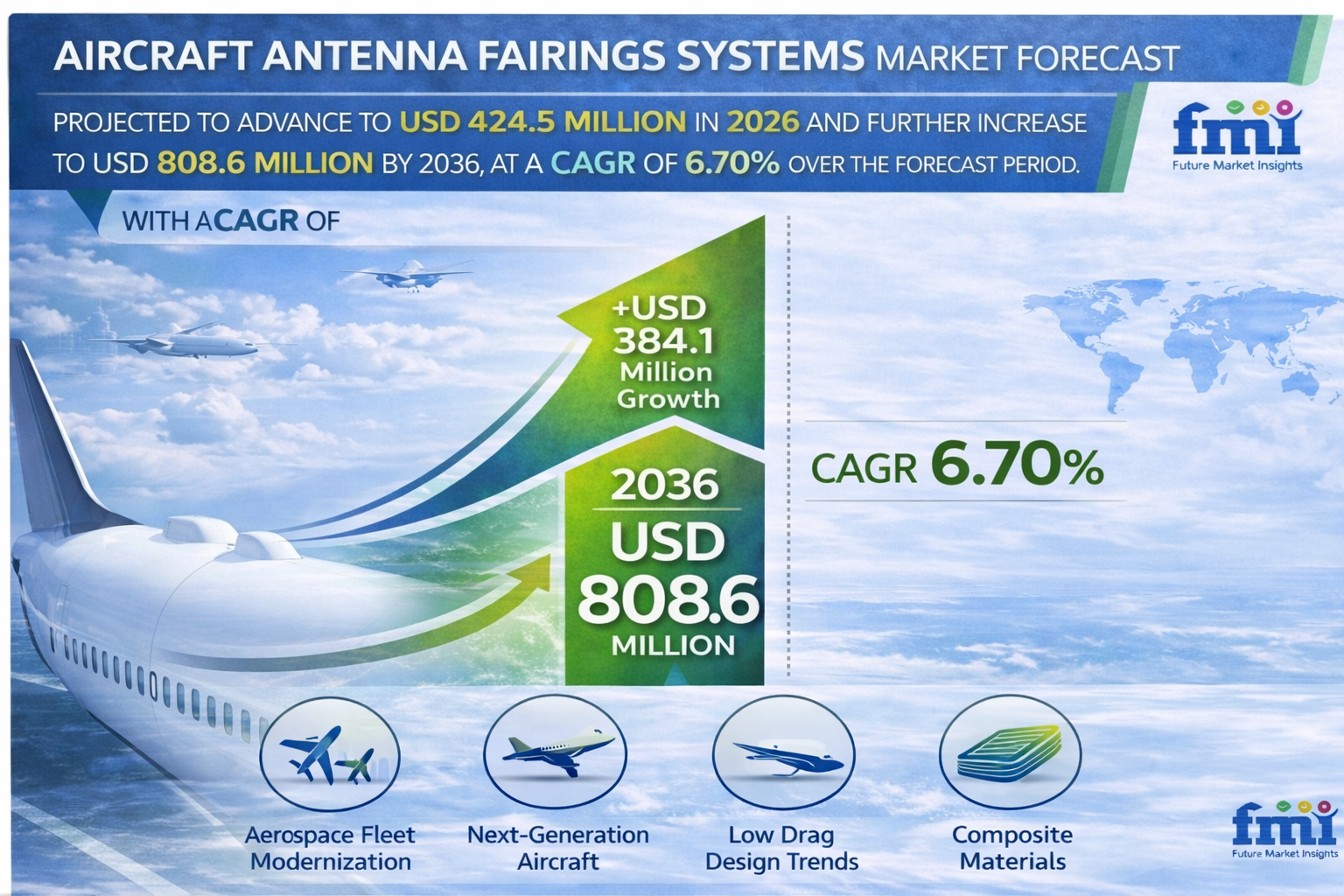
NEWARK, DE / ACCESS Newswire / March 22, 2026 / The global aircraft antenna fairing systems market is entering a connectivity-driven expansion phase as airlines accelerate investments in advanced communication infrastructure across both new and aging fleets. Valued at USD 398.0 million in 2025, the market is projected to reach USD 424.5 million in 2026 and further expand to USD 808.6 million by 2036, registering a CAGR of 6.70% during the forecast period.
This steady growth reflects a structural transformation in the aviation industry, where inflight connectivity is evolving from a premium feature to a baseline passenger expectation. Aircraft antenna fairing systems-engineered aerodynamic enclosures designed to protect communication antennas while ensuring uninterrupted signal transmission-are becoming critical components in enabling high-speed broadband connectivity at cruising altitudes.
Get Access of Report Sample:
https://www.futuremarketinsights.com/reports/sample/rep-gb-32396
Market Value Analysis: Connectivity Upgrades Driving Structural Innovation
Between 2026 and 2030, the aircraft antenna fairing systems market is expected to witness sustained demand as airlines modernize fleets with next-generation satellite communication (SATCOM) capabilities. The push for seamless inflight internet, real-time data exchange, and operational efficiency is compelling operators to retrofit existing aircraft with advanced radome systems.
However, integrating larger, multi-band antenna arrays introduces a complex engineering challenge. Fairing systems must balance radio frequency (RF) transparency with structural durability, ensuring minimal signal attenuation while withstanding extreme aerodynamic loads, temperature variations, and environmental exposure.
From 2030 to 2036, market expansion will be driven by the adoption of advanced composite materials, hybrid laminate structures, and embedded lightning protection technologies. These innovations will enable the development of lighter, stronger, and more aerodynamically efficient fairings capable of supporting next-generation broadband systems without compromising aircraft performance.
Technology Evolution: Composite Materials and RF Transparency Redefining Performance
Aircraft antenna fairing systems are evolving rapidly through the integration of advanced material science and aerodynamic engineering. Modern fairings incorporate:
RF-transparent composite laminates for uninterrupted signal transmission
Embedded lightning diverter systems for enhanced safety compliance
Aerodynamically optimized contours to reduce drag and fuel consumption
Impact-resistant structures designed to withstand bird strikes and debris
Thermal-resistant coatings to endure extreme altitude conditions
A major breakthrough lies in the development of hybrid composite matrices that maintain signal clarity while improving structural resilience. These materials allow engineers to design thinner yet stronger radomes, addressing the long-standing tradeoff between RF performance and mechanical integrity.
An industry analyst notes:
"The future of aircraft antenna fairings lies in achieving perfect balance-maximizing signal transparency without sacrificing aerodynamic efficiency or structural safety. Suppliers that master this equilibrium will lead the next wave of aviation connectivity."
Precision Aerostructure Engineering Becoming Critical to Aviation Connectivity
As airlines expand inflight connectivity offerings, antenna fairing systems are transitioning from auxiliary components to mission-critical aerostructures. These systems enable:
High-speed satellite internet for passengers
Real-time aircraft health monitoring and data transmission
Enhanced navigation and communication capabilities
Integration of multi-band and electronically steered antennas
Continuous global connectivity across long-haul routes
This transformation is redefining aircraft design priorities, where connectivity performance is now closely tied to passenger satisfaction, operational efficiency, and airline competitiveness.
Segment Spotlight
Low-Profile Satcom Fairings Lead Type Segment (37.0%)
Low-profile radome fairings dominate due to increasing demand for aerodynamic designs that support high-bandwidth satellite systems without increasing drag.
Composite Materials Dominate Material Segment (46.0%)
Advanced composites lead the market as they offer superior strength-to-weight ratios and RF transparency compared to traditional fiberglass materials.
Satellite Communication Applications Lead (34.0%)
SATCOM fairing systems are the fastest-growing segment, driven by the global push for uninterrupted inflight broadband connectivity.
Commercial Aircraft Dominate End-Use Segment (43.0%)
Commercial transport aircraft account for the largest share, supported by large-scale retrofit programs and new aircraft deliveries.
Regional Insights: North America and Asia-Pacific Driving Adoption
North America is expected to maintain a leading position in the aircraft antenna fairing systems market, driven by strong demand for fleet-wide connectivity upgrades and stringent regulatory standards.
Asia-Pacific is emerging as a high-growth region, supported by rapid fleet expansion and increasing passenger demand for digital services.
Country |
CAGR (2026-2036) |
Key Growth Drivers |
|---|---|---|
United States |
7.3% |
Strong demand for broadband-enabled fleets |
China |
7.1% |
State-backed aviation modernization programs |
UAE |
7.0% |
Premium long-haul carriers investing in connectivity |
France |
6.8% |
Established aircraft manufacturing ecosystem |
United Kingdom |
6.6% |
Advanced composite engineering capabilities |
Singapore |
6.5% |
Regional hub for aviation maintenance and upgrades |
Germany |
6.4% |
Stringent certification driving high-quality adoption |
Opportunities: Advanced Materials and Smart Fairings Unlock Growth Potential
The market is witnessing new growth opportunities driven by innovation in materials and smart technologies, including:
Self-healing coatings to reduce maintenance and extend lifecycle
Embedded structural health monitoring sensors
Acoustic metamaterials for noise reduction
Lightweight hybrid composites for improved fuel efficiency
Advanced erosion-resistant coatings for harsh environments
These advancements are enabling next-generation fairing systems that enhance both performance and durability while reducing operational costs.
Competitive Landscape: Aerospace Leaders Driving Innovation
The aircraft antenna fairing systems market is characterized by a concentrated group of aerospace suppliers specializing in advanced aerostructures and connectivity solutions.
Leading companies include:
Astronics Corporation
HEICO Corporation (Sensor Systems)
Honeywell Aerospace
ThinKom Solutions
Gilat Satellite Networks / Stellar Blu
Collins Aerospace
Competitive differentiation is increasingly driven by material innovation, certification expertise, and the ability to deliver high-performance, lightweight fairing systems that meet stringent aviation standards.
Future Outlook: Connectivity Becoming Core to Aircraft Design
Looking toward 2036, aircraft antenna fairing systems will play a central role in enabling the next generation of connected aviation ecosystems.
Key trends shaping the market include:
Integration of multi-band and phased-array antennas
Expansion of global satellite constellations
Increasing demand for real-time data connectivity
Adoption of lightweight, high-performance composite materials
Growth in retrofit programs for legacy aircraft
As airlines continue to prioritize passenger experience and operational efficiency, aircraft antenna fairing systems will become indispensable components-ensuring seamless connectivity while maintaining the highest standards of safety and performance.
For an in-depth analysis of evolving formulation trends and to access the complete strategic outlook for the Aircraft Antenna Fairing Systems Market through 2036, visit the official report page at: https://www.futuremarketinsights.com/reports/aircraft-antenna-fairing-systems-market
Browse More Automotive Industry Reports:
Aircraft Gearbox Market - https://www.futuremarketinsights.com/reports/aircraft-gearbox-market
Two-Wheeler Aftermarket Components & Consumables Market - https://www.futuremarketinsights.com/reports/two-wheeler-aftermarket-components-market
One-Pedal Brake Control Modules Market - https://www.futuremarketinsights.com/reports/one-pedal-brake-control-modules-market
Low-Noise Low-Dust EV Brake Components Market - https://www.futuremarketinsights.com/reports/low-noise-low-dust-ev-brake-components-market
Regenerative Brake Calibration Services Market - https://www.futuremarketinsights.com/reports/regenerative-brake-calibration-services-market
About Future Market Insights (FMI)
Future Market Insights (FMI) is a leading provider of market intelligence and consulting services, serving clients in over 150 countries. Headquartered in Delaware, USA, with a global delivery center in India and offices in the UK and UAE, FMI delivers actionable insights to businesses across industries including automotive, technology, consumer products, manufacturing, energy, and chemicals.
An ESOMAR-certified research organization, FMI provides custom and syndicated market reports and consulting services, supporting both Fortune 1,000 companies and SMEs. Its team of 300+ experienced analysts ensures credible, data-driven insights to help clients navigate global markets and identify growth opportunities.
For Press & Corporate Inquiries
Rahul Singh
AVP - Marketing and Growth Strategy
Future Market Insights, Inc.
+91 8600020075
For Sales - sales@futuremarketinsights.com
For Media - Rahul.singh@futuremarketinsights.com
For web - https://www.futuremarketinsights.com/
SOURCE: Future Market Insights, Inc.
View the original press release on ACCESS Newswire