

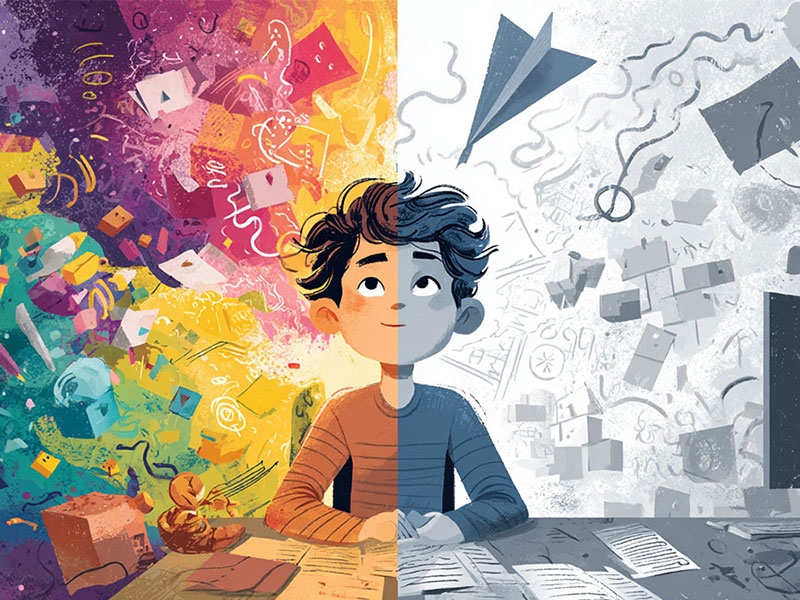
A sweeping examination of decades of creativity research has revealed that 98% of children test at creative genius levels at age five - yet by age fifteen, that figure collapses to just 2%. The findings, drawn from a NASA-commissioned longitudinal study by Dr. George Land and Dr. Beth Jarman tracking 1,600 children from 1968 to 1978, alongside subsequent analysis of over 272,000 Torrance Test results, point to one primary culprit: the education system.
The research, detailed in a comprehensive new analysis titled “Why 98% of Children Are Creative Geniuses at Age 5, But Only 2% at Age 15,” documents how standardized testing, curriculum narrowing, and risk-averse teaching have systematically suppressed the divergent thinking that underlies human innovation, problem-solving, and economic growth.
Key Findings
• At age 3–5, 98% of children scored at creative genius level on divergent thinking tasks (Land & Jarman, 1992). By age 10, only 30% remained at that level. By age 15, the figure dropped to 12%, and among adults, just 2% qualify.
• Professor Kyung Hee Kim’s analysis of 272,599 Torrance Tests of Creative Thinking (1966–2008) confirmed a sustained creativity decline beginning in 1990 — the same period standardized testing became dominant in American schools.
• The steepest decline was in “elaboration” — the ability to develop and expand ideas — which fell more than one standard deviation between 1984 and 2008. Over 85% of children in 2008 scored lower on this measure than the average child in 1984.
• IQ scores rose during the same period that creativity scores fell, demonstrating these are distinct capacities requiring distinct educational approaches.
• Project-based learning interventions produced a 0.626 effect size improvement in creative thinking — among the highest-impact educational interventions measured — while also improving AP exam pass rates by 8–10 percentage points.
“Creative potential doesn’t disappear — it goes dormant. Land’s own research found that adults can return to 98% creative capacity when allowed to separate divergent and convergent thinking. The ability is suppressed, not lost. The question is whether we will stop suppressing it.” – says Bogdan Sandu from Russell Collection
Why This Matters
The stakes extend well beyond the classroom. In a 2010 survey of 1,500 global CEOs, IBM identified creativity as the single most important leadership competency for the future. An Adobe study found that 80% of people believe creativity is critical to economic growth, yet only 25% feel they are living up to their creative potential — and 70% of Americans believe education systems are actively stifling it.
The economic consequences are compounding. Arts programs have been eliminated from approximately 30% of public schools. In Oklahoma alone, over 1,110 fine arts classes were cut between 2014 and 2018. Nationally, music and visual arts are offered in only 4% of elementary and secondary schools. Budget cuts have disproportionately affected low-income districts, deepening existing inequalities.
Proven Solutions Exist
The analysis highlights evidence-based interventions already producing measurable results. Schools implementing project-based learning — such as High Tech High in San Diego and New Technology High School in Napa — are outperforming traditional classrooms on both standardized tests and creative thinking assessments. STEAM integration (Science, Technology, Engineering, Arts, and Mathematics) has demonstrated enhanced creativity, improved problem-solving, and higher science achievement across diverse student populations.
International comparisons are instructive. Finland, which eliminated national standardized tests in grades 1–9 and prioritizes arts and play, consistently produces strong academic outcomes alongside high creative capacity. Singapore, after shifting from test-focused to creativity-centered education since the 1990s, now ranks first globally in creative thinking (PISA 2022). Meanwhile, China and South Korea — historically test-centric systems — are actively working to move away from models the United States continues to adopt.
About the Research
This analysis synthesizes findings from Land, G., & Jarman, B. (1992), Breakpoint and Beyond: Mastering the Future Today (HarperBusiness); Kim, K. H. (2011), “The Creativity Crisis,” Creativity Research Journal, 23(4); the IBM Global CEO Study (2010); Adobe State of Create (2012); and multiple peer-reviewed studies on project-based and STEAM-integrated learning published between 2019 and 2024.
Media Contact
Bogdan Sandu
Editor
https://russell-collection.com/
Media Contact
Company Name: Russell Collection
Contact Person: Bogdan Sandu
Email: Send Email
Country: United States
Website: https://russell-collection.com/